Keep up with the latest FinTech and private market news, business tips, and thought leadership from industry leaders, mentors, and professionals.
Join our mailing list to receive information on upcoming Helicap platform updates and webinars.

If you're excited about the potential of private markets and fintech, we've got a job for you.
IMPORTANT NOTICE: This article is for general informational purposes only and does not constitute financial advice, a recommendation, an offer, or a solicitation to invest in any financial product. Any investment products referenced are offered only to verified Accredited Investors and Institutional Investors (each as defined in Section 4A of the Securities and Futures Act 2001). Dealing services are provided by Helicap Securities Pte. Ltd., and fund products are managed by Helicap Investments Pte. Ltd. If you are not an Accredited Investor or Institutional Investorthe investment products referenced in this article are not available to you. All investments carry risk, including the possible loss of principal. Past performance is not indicative of future results.
Alternative investments are financial assets outside publicly traded stocks, bonds, and cash.
These investments are privately structured, less liquid, and accessed through fund vehicles or direct arrangements. Their returns tend to be driven by private market fundamentals rather than daily market sentiment.
Investors access them through private arrangements or specialist fund structures rather than public exchanges, across asset classes including private credit, private equity, hedge funds, real estate, and infrastructure.
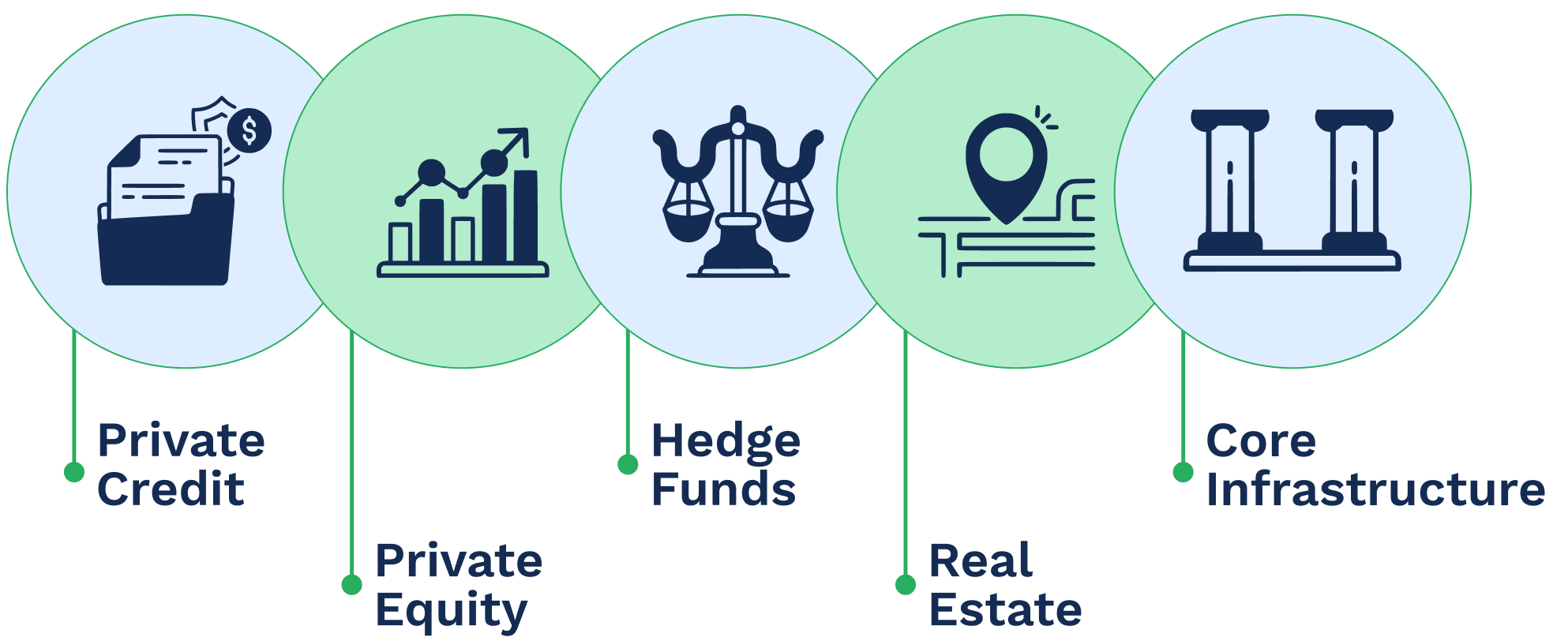
Two factors in particular have helped shape the growth of alternative investing in Singapore: a structural shift in how institutions allocate capital, and the city-state's emergence as the region's primary hub for private market activity, as noted by both Chambers and Partners and the MAS 2024 Asset Management Survey.
Institutional investors and family offices have steadily increased allocations to alternative investment funds over the past decade.
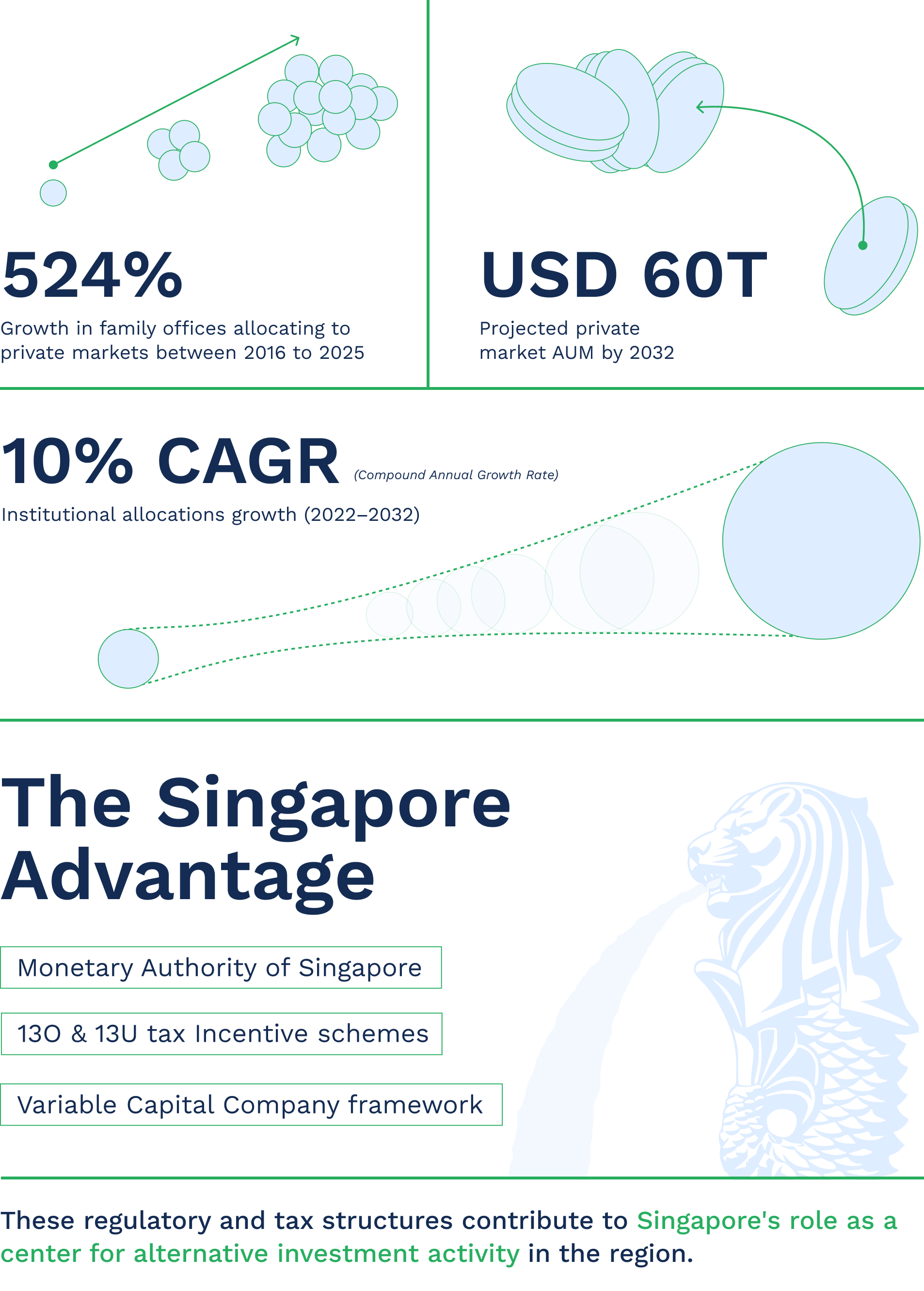
According to Preqin data reported by CNBC, the number of family offices with allocations to private markets surged by 524% between 2016 and 2025, rising from 651 to over 4,000 globally. Among the draws are the return streams with historically lower correlation to public markets and income potential from private credit strategies.
As public market volatility has become more pronounced, the case for private market diversification has broadly strengthened across investor mandates globally. Bain & Company research cited by the MAS projects that institutional allocations to alternative assets will grow at a 10% compound annual growth rate from 2022 to 2032, reaching at least USD 60 trillion in private market AUM by that point.
Singapore has become a significant hub for alternative investments in the region. It attracts regional and international capital into alternative investments, and is supported by several regulatory frameworks administered by the Monetary Authority of Singapore (MAS).
For example, the Variable Capital Company (VCC) framework, introduced in 2020, provides a flexible and tax-efficient corporate structure for investment funds, allowing sub-funds to share operational infrastructure while maintaining segregated assets and liabilities.
Fund managers operating in Singapore may also qualify for the 13O and 13U tax incentive schemes, which provide qualifying income tax exemptions for funds managed by Singapore-based managers.
Taken together, these structures provide clarity for managers and investors deploying capital across private credit, private equity, and alternative investment fund strategies, and support Singapore's position as a centre for private market and alternative investment activity in Asia.
The more commonly accessed types of alternative investments for accredited investors in Singapore are private credit, private equity, and hedge funds, each offering a distinct approach to generating returns outside public markets.
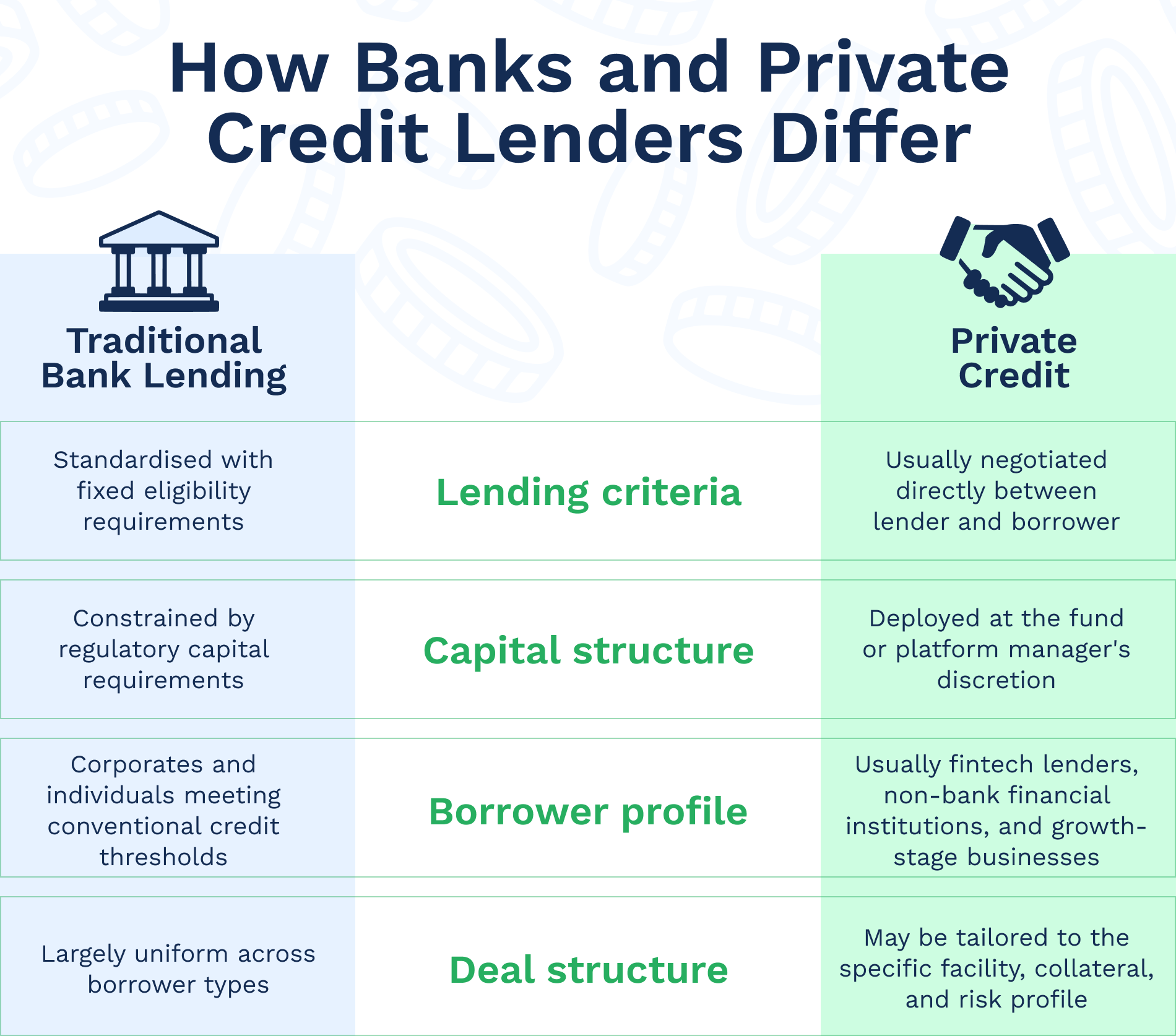
Private credit investing involves lending capital directly to businesses outside the banking system, such as fintech lenders, non-bank financial institutions, and growth-stage companies. These borrowers require flexible financing that conventional bank loans do not accommodate.
Income is typically generated through regular interest payments rather than equity price appreciation. Examples of structures that are relevant within private credit:
Private equity involves acquiring ownership stakes in private companies, with returns typically realised over a multi-year horizon through business growth or an exit event. It requires patient capital and a longer investment horizon than most private credit or public market strategies.
Hedge funds deploy strategies including long/short equity, global macro, and credit arbitrage seeking returns with lower correlation to traditional indices.
Hedge funds and alternative investments such as private credit are among the strategies accredited investors use to seek return streams that are less correlated with listed markets.
Access is generally restricted to institutional and accredited investors with substantial minimum commitments.
Subject to the risks set out above, allocating to alternative investments may offer accredited and institutional investors diversified income streams which are historically less sensitive to daily public market fluctuations.
Asset classes such as private credit, private equity, and hedge funds may seek to capture the illiquidity premium through privately structured arrangements outside of traditional exchanges.
According to the MAS 2024 Asset Management Survey, 88% of Singapore-managed AUM is invested globally, with private credit investments rising 21% year-on-year. Private credit has become a core allocation for many institutional investors, valued for its risk-adjusted returns and diversification, as noted at the AIMA Private Credit Investor Forum 2025. For accredited and institutional investors, the features commonly cited includes
An alternative investment fund is a pooled vehicle that collects capital from eligible investors and deploys it across a defined private market strategy under professional management. The fund manager oversees origination, structuring, and ongoing monitoring, typically with quarterly portfolio reports.
A practical list of alternative investment funds includes private credit funds, private equity funds, hedge funds, real estate funds, and infrastructure funds, each targeting a distinct asset class and investment horizon.
Private credit funds focus on income generation through direct lending, while private equity funds tend to pursue capital appreciation through ownership stakes in private companies held over a longer period.
For investors evaluating an alternative investment fund in Singapore, the primary considerations are the fund manager's track record, structural protections such as senior secured positioning, and the approach to ongoing portfolio monitoring.
Access is generally restricted to accredited and institutional investors as defined under the Securities and Futures Act and overseen by the MAS.
Private Credit investing refers to the deployment of capital through privately negotiated lending arrangements, outside the scope of public debt markets or traditional bank financing.
Traditional banks lend against standardised criteria and are subject to regulatory capital constraints. Private credit lenders may operate with greater flexibility in structuring terms, collateral arrangements, and facility size, often serving borrowers that fall outside conventional bank credit channels.
Across emerging and developing markets, Micro, Small and Medium Enterprises (MSMEs) face an estimated US$5.7 trillion financing gap that formal lenders do not meet, and East Asia and the Pacific accounts for the largest share of this demand.). This unmet need has created sustained demand for private lending capital beyond what traditional financial institutions provide.
As borrowers make interest payments across the portfolio, income is distributed to investors on a periodic basis, usually quarterly, providing a regular income cadence that listed instruments do not consistently replicate.
Senior secured positioning shapes portfolio construction. Lenders hold a priority claim on collateral and they may be able to maintain tighter covenants, price risk more accurately, and hold greater leverage in restructuring scenarios. These features may mitigate loss but do not eliminate the risk of loss in periods of borrower stress.
In Singapore, access to private market opportunities is governed by the eligibility framework set out under the Securities and Futures Act and administered by the MAS.
As the MAS notes, private funds are offered exclusively to accredited and institutional investors, with fund managers required to hold a Capital Markets Services licence or qualify under applicable exemptions.
Investors who meet these criteria can access these markets through several routes, each with a distinct risk profile and level of manager involvement.
For investors who prefer diversified exposure without deal-by-deal selection, a fund subscription provides access to a professionally managed portfolio across multiple originators, borrowers, and geographies. Capital is allocated by the fund manager according to risk, pricing, and portfolio construction objectives, with quarterly reporting on performance.
Investing in a specific facility with defined terms, collateral, and return profile may offer greater visibility into individual exposures, across geographies and lending segments such as MSME or fintech lending in Asia. This is general information about the strategy and is not an offer of, or an invitation to invest in, any specific facility.
Digital platforms operating under regulated frameworks allow eligible investors to discover, assess, and transact in private market opportunities, often bringing deal documentation and credit analytics together in one place. The blog, How to Invest in Private Credit, outlines this process in more detail.
Assessing private market opportunities calls for granular analysis of risk-adjusted returns and structural safeguards.
Assessing private credit is generally understood to go beyond surface-level credit quality to encompass manager experience, structural protections, and performance across credit cycles.
For instance, in assessing private credit opportunities, the evaluation framework shifts from public credit ratings to direct underwriting rigour, which examines not only the instrument's position in the capital stack, but also the operational and governance quality of the manager behind it.
Asia's private credit market has grown at a compound annual growth rate of over 20% in the past five years, according to Chambers and Partners. Data-driven underwriting practices and stronger regulatory frameworks across the region have contributed to a more accessible and well-defined pipeline for private credit capital compared to earlier market cycles.
Alternative investments refer to financial assets outside publicly traded stocks, bonds, and cash. They include private credit, private equity, hedge funds, real estate, and infrastructure, accessed through private arrangements or fund structures.
For accredited and institutional investors in Singapore, the most common types of alternative investments include private credit, private equity, and hedge funds, alongside real assets such as real estate and infrastructure.
An alternative investment fund is a pooled vehicle where a professional fund manager allocates investor capital across a private market strategy, with investors potentially receiving returns through distributions or income and portfolio updates typically on a quarterly basis.
Yes, alternative investments are available to accredited and institutional investors as defined under the Securities and Futures Act.. However, eligible investors should confirm their status with the relevant manager or platform before investing.
Accredited investors are allocating more capital to alternative investments in pursuit of return streams with lower public market correlation, structural downside protections, and diversification across private market strategies unavailable through listed vehicles.
This depends on the individual's investment objectives and risk tolerance. Senior secured private credit has historically offered income distributions with senior secured positioning that may reduce, but does not eliminate, loss severity in stress scenarios.
Traditional investments trade on public exchanges, generally with higher liquidity and more transparent pricing. Alternative investments are privately structured, less liquid, and accessed through fund vehicles or direct arrangements, with returns driven by private market fundamentals rather than market movements.
This article is for general informational purposes only and does not constitute financial advice, a recommendation, an offer, or a solicitation to invest in any financial product. Any investment product referenced is offered only to verified Accredited Investors and Institutional Investors (each as defined in Section 4A under the Securities and Futures Act 2001). If you are not an Accredited Investor or Institutional Investor, the investment products referenced in this article are not available to you. All investments carry risk, including the possible loss of principal. Past performance is not indicative of future results.



Investment involves risk. Past performance is not necessarily a guide to future performance or returns. The value of investments and the income from them can go down as well as up, and you may not get the full amount you invested. Rates of exchange may cause the value of investments to go up or down.
Any forward-looking statements, prediction, projection or forecast on the economy, stock market, bond market or economic trends of the markets contained in this material are subject to market influences and contingent upon matters outside the control of Helicap Pte. Ltd. (“Helicap”) and therefore may not be realised in the future. Further, any opinion or estimate is made on a general basis and subject to change without notice. In presenting the information above, none of Helicap, its affiliates, directors, employees, representatives or agents have given any consideration to, nor have made any investigation of the objective, financial situation or particular need of any user, reader, any specific person or group of persons. Therefore, no representation is made as to the completeness and adequacy of the information to make an informed decision. You should carefully consider (i) whether any investment views and products/ services are appropriate in view of your investment experience, objectives, financial resources and relevant circumstances. You may also wish to seek financial advice through a financial advisor or and independent legal, accounting, regulatory or tax advice, as appropriate.