Keep up with the latest FinTech and private market news, business tips, and thought leadership from industry leaders, mentors, and professionals.
Join our mailing list to receive information on upcoming Helicap platform updates and webinars.

If you're excited about the potential of private markets and fintech, we've got a job for you.
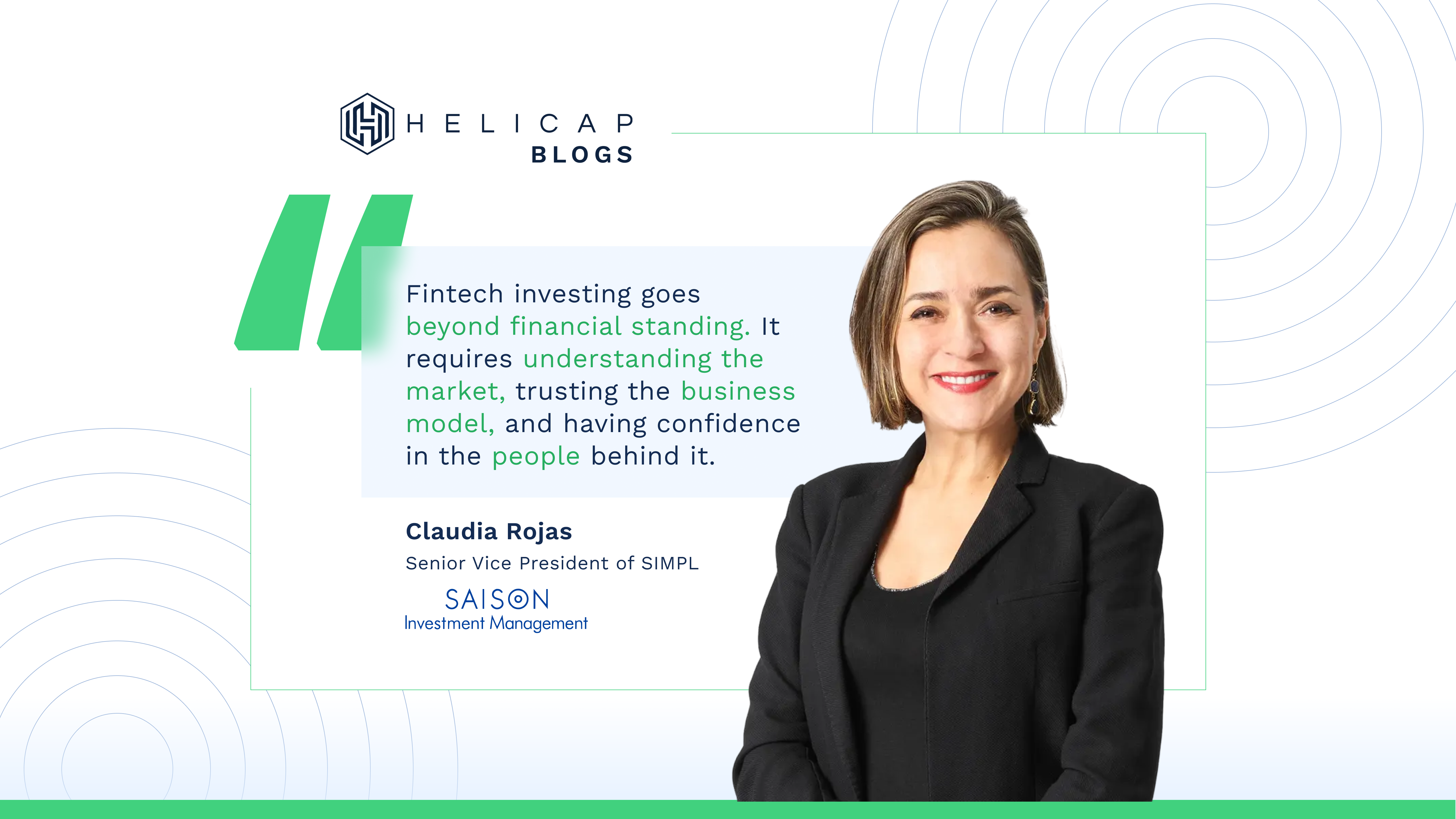
Beyond the Balance Sheet marks its 10th edition with an inspired conversation featuring Claudia Rojas, Senior Vice President at Saison Investment Management Private Limited (SIMPL), whose work centres on emerging markets across Latin America and Southeast Asia.
Claudia brings more than two decades of international experience in finance and trade policy to her role at SIMPL, where she has grown its cross-border lending portfolio to over USD 100M. Her work spans four investments in the Philippines alone, and most recently extended into Mongolia through a second green loan partnership with Golomt Bank, aimed at expanding financial inclusion and supporting the country's climate goals.
That track record is rooted in an unconventional path: from trade negotiations in Colombia, to development finance at the United Nations, to over a decade in credit risk and portfolio management at Triple Jump before joining SIMPL. It is a path that shaped not just where she invests, but how she thinks about risk, resilience, and impact, as this conversation goes on to explore.
From Wall Street to Main Street
Helicap: Your career arc is fascinating—from Citi and S&P Global to co-founding Latin Express helping Hispanic immigrants, then into impact-driven microfinance. What prompted you to pivot from traditional finance to social impact, and how did that entrepreneurial experience shape your investment philosophy today?
Claudia Rojas:
I am very lucky to have lived such a varied experience in different jobs and countries. It might look like too many deviations, but it all had a purpose. I grew up in a developing country where inequality is huge. During my school and university years we lived through a period of internal conflict and violence. While this taught me, as to all Colombians from my generation, to be very resilient, I decided I had a purpose and needed to do something for my community and country.
I first studied economics and started my first job at Citi. I learned a lot about finance, but I soon realized that that job was not rewarding enough in terms of giving and contributing to society. So, I left this “stellar job that made my parents happy” to study development in the Netherlands and came back to join the Colombian government. I worked for the Ministry of Trade and then worked with the Colombian Association of Entrepreneurs. I was convinced that supporting the private sector was the way to advance and achieve sustainable growth.
I was then granted a scholarship to do an MPA at Columbia University and left my country 22 years ago. In NYC, I had a paid internship at S&P, but again, felt that something was missing. I left to join the United Nations Capital Development Fund during the Year of Microcredit. This was, with no doubt, one of the best decisions as it was when I found my Ikigai — I could do something I was passionate about, putting in practice my financial skills, helping the world and making a living out of it! I have since then been very loyal to my Ikigai.
Parallel to this, I have also co-founded a company that supported Latin American Immigrants with the paperwork they needed from their countries of origin to regularize their status in the US. This entrepreneurial spirit has been put in practice at Saison, which I joined almost four years ago when we were still a startup and each one of us needed to roll our sleeves and do anything that was needed: from thinking of the strategy for SIMPL, helping set up the Mexican office, to creating policies and originating and executing. Funny enough, many of Saison’s employees were or are entrepreneurs themselves!
The Economist Who Became a Dealmaker
Helicap: You started as an economist working on trade negotiations for the Colombian government, then transitioned into credit and investment roles. How did those early experiences in policy and macroeconomics influence how you evaluate fintech opportunities and emerging market risks today?
Claudia Rojas:
It taught me to be very good at negotiating! At work, we have secured some good deals thanks to these skills, though you can also ask my husband — you need a lot of negotiation skills for a successful 23-year marriage! 😊
SIMPL’s work, much like Helicap’s, is not easy. We need to work in emerging markets with large macro, cultural and regulatory differences. For our job, we need to really understand the local ecosystems before we can evaluate an investment opportunity.
Bridging Two Worlds
Helicap: You've successfully led SIMPL's expansion across both Latin America and Southeast Asia—two very different markets. What are the most surprising similarities you've discovered between these regions, and what unique lessons has each geography taught you about financial inclusion?
Claudia Rojas:
Both regions share large, underserved populations and significant SME credit gaps. Despite small businesses being key drivers of their economies, traditional banking systems remain highly concentrated and often show limited interest in serving these segments, particularly those unable to provide hard collateral.
We also see persistently high interest rates in markets such as Mexico, Brazil, and the Philippines, alongside a continued reliance on cash. This is largely driven by the size of informal economies and a lingering lack of trust in financial institutions.
As a result, there is a clear need across both regions for innovative solutions that can meaningfully expand financial inclusion. Opportunities are also immense, given the young and tech-savvy population.
In terms of lessons, we have seen several embedded finance solutions in SEA, and hybrid models consistently outperforming purely digital approaches. In contrast, Latin America highlights the critical role of regulation in shaping markets. Initiatives such as open banking frameworks and government-led payment systems like Pix in Brazil, CoDi in Mexico, and Bre-B in Colombia are transforming the financial landscape and accelerating inclusion.
The Singapore Perspective
Helicap: After spending over a decade in Mexico City leading Triple Jump's regional operations, you relocated to Singapore. How has operating from Asia's fintech hub changed your perspective on Latin America's potential, and vice versa?
Claudia Rojas:
Before landing in Singapore, I realized that actors in LATAM and SEA knew very little about one another, as they are literally on opposite sides of the world. Thanks to very visionary leaders, Saison has adopted a strategy that treats both regions as complementary playbooks.
Having grown as a Group in large markets such as India and across various other Asian countries through SIMPL and Saison Capital (Credit Saison’s venture capital arm), we established our businesses in Mexico and Brazil three years ago. The success of these initial efforts has opened doors to greater appetite for LATAM opportunities. We observe that markets sharing historical and cultural ties, along with some regulatory alignment, often behave as a bloc, allowing fintechs to regionalize and scale faster.
LATAM's historically high macro volatility, combined with significant financial inclusion gaps across countries, has also created strong demand for innovative financial tools. We are impressed by the strength of institutions, proactive regulators, innovative fintechs, and highly professional founders in these markets.

Helicap: In April 2024, SIMPL started by investing US$5 million in Billease. You noted that "our partnership with Billease through Helicap is driving financial inclusion by building a credit history for a large share of their customers, and creating meaningful impact for a broader segment of the population in the Philippines." How do you evaluate and select co-investment partners like Helicap, and what role do they play in SIMPL's strategy to scale impact across Southeast Asia's underbanked markets?
Claudia Rojas:
Our story with Helicap is special, as we have various separate links that tie SIMPL to them: Credit Saison’s VC arm (Saison Capital) has invested since the early years, and SIMPL is invested in Helicap Private Credit Fund. We have also done syndications with Helicap Securities. This proves the trust we have in the teams and the shared goals. We value this close relationship that has helped both institutions to grow.
Helicap is not the only partnership we engaged in the early days to grow faster through syndications, but it is the one closer to our hearts.
The Philippines as a Strategic Hub
Helicap: SIMPL has now completed three cross-border loan facilities in the Philippines — with Billease (urban consumers), Country Funders (rural farmers), and First Circle (SMEs) — covering diverse underserved segments. You mentioned that these partnerships are "designed to support segments traditionally excluded by banks, ranging from urban consumers to rural farmers and SMEs." What makes the Philippines particularly compelling for SIMPL's impact investing thesis, and how does the country's financial inclusion landscape compare to other frontier markets you've worked in across Latin America and Southeast Asia?
Claudia Rojas:
In addition to the three mentioned institutions, we also have a microfinance institution called One Puhunan, member of the Credit Access Group, which was our first investment in the country. With the four institutions, we cover microfinance, consumer, and SME lending, as well as motorcycle financing, a fast-growing sector.
The Philippines is the second most populated country in SEA with ~120 million inhabitants. With this size, the country has tens of millions of underbanked consumers; but these consumers are young, tech savvy, have familiarity with remittances and speak perfect English. These cultural attributes, combined with regulatory uncertainty and a huge concentration in few financial institutions, are fertile grounds for market opportunity for innovative fintechs.
Scaling with Discipline
Helicap: Growing a portfolio from under $10M to over $100M in three years is exceptional. What's your philosophy on balancing aggressive growth with prudent risk management, and can you share a deal you walked away from that others might have taken?
Claudia Rojas:
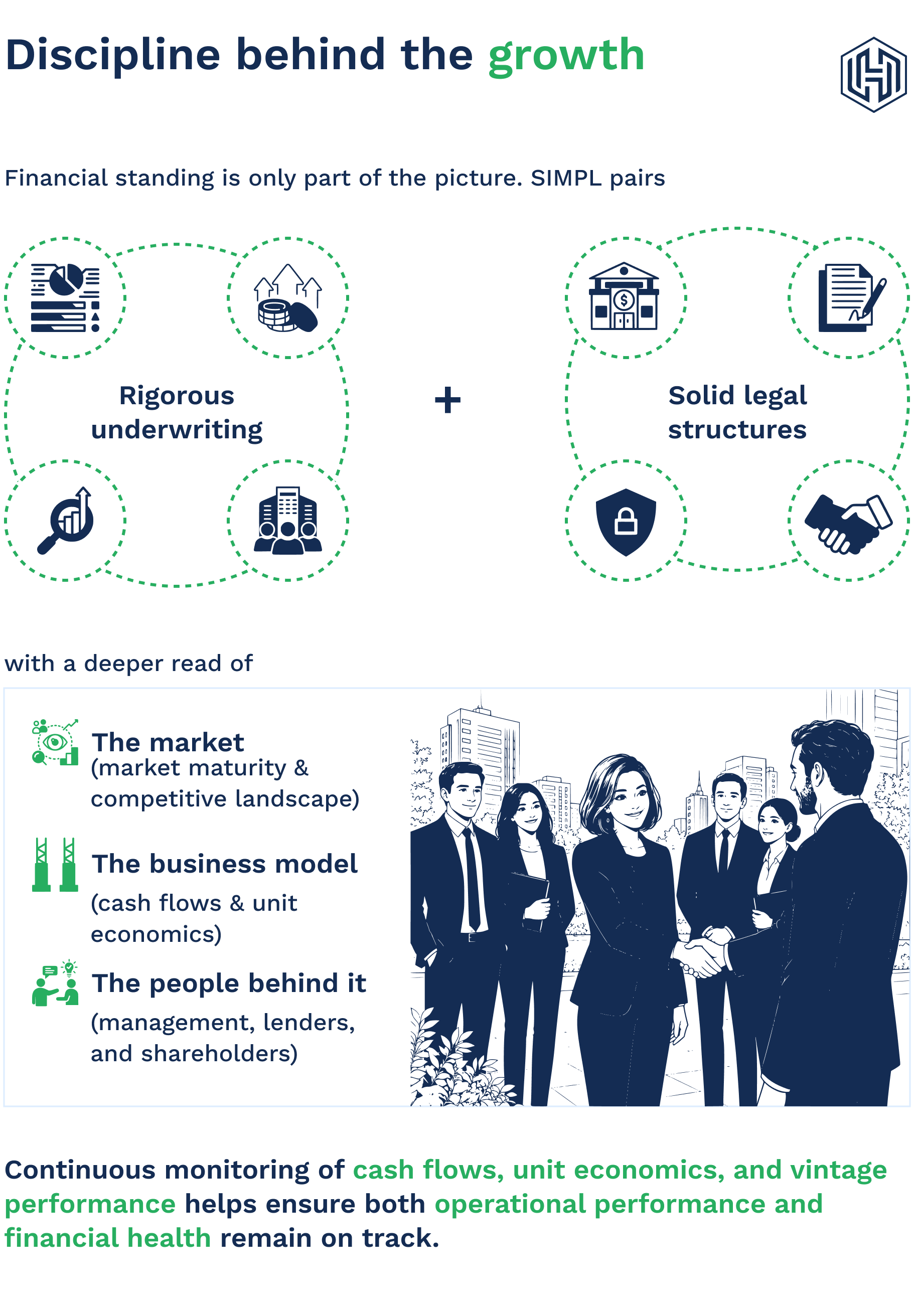
Saison has many years of experience supporting fintechs. We not only do intensive and rigorous financial underwriting, but we also set up solid legal structures. We are constantly learning and implementing best practices.
Early Warning Systems
Helicap: At Triple Jump, you were responsible for coordinating portfolio monitoring and managing distressed loans. What early warning signals do you watch for now at SIMPL, and how has your approach to credit risk evolved from microfinance to fintech lending?
Claudia Rojas:
Fintech ecosystems are generally at an earlier stage than global microfinance markets, which means it is common to encounter institutions that are still loss-making or still proving their business models. For fintech investments, this requires looking beyond financial standing: it is essential to understand the market, trust the business model, and have confidence in the people behind it — management, lenders, and particularly shareholders.
We also pay close attention to cash flows and unit economics to verify that the business is sustainable. On the legal side, structured deals are a standard practice in the fintech world.
At SIMPL, we maintain close communication with our investees and continuously conduct vintage analyses to monitor credit quality over time. This disciplined approach helps ensure that both operational performance and financial health are on track.
Bridging Two Worlds
Helicap: Research shows that only 12% of fintech founders are women, and gender-diverse funds often outperform their peers by 10-20%. As one of the women leading a major impact investment platform in Asia, what barriers have you encountered, and what advice would you give to women entering this space?
Claudia Rojas:
While there are undeniable physiological differences between men and women, many of the challenges women face stem from preconceived notions that still need to be overcome.
In my experience, the biggest challenges were not due to my gender, but to the complexities of being a mother. I had to actively carve out my space, advocating for flexible schedules and remote work, and pushing for institutional changes that better support working parents. In doing so, I hope I have also helped clear the path for future generations. Work flexibility and strong family support have been essential in my journey. They have enabled me to raise my children while continuing to grow professionally, taking on leadership responsibilities, managing teams, and contributing to the broader vision and growth of my company.
I also believe that discrimination is gradually diminishing. Increasingly, individuals are judged based on their experience and achievements rather than their gender. A clear example is Saison International, where many leaders across both functional and business teams are women. SIMLP itself is formed by talented women!
My advice to others is this: don’t try to fit into traditional, male-dominated structures. Instead, help build systems that embrace flexibility — especially for motherhood — while actively celebrating diversity. But please don’t cover inefficiencies with motherhood or women-related aspects. That is how we create truly inclusive and sustainable workplaces.
Leadership as the Head of SIMPL
Helicap: What leadership principles guide you, and how do you build diverse teams that can navigate the complex intersection of fintech, financial inclusion, and emerging markets?
Claudia Rojas:
I lead first by example. Commitment, loyalty, and hard work are contagious: there is nothing more powerful than seeing your manager consistently demonstrate these values.
When building a team, I look for passion, not only for the work itself, but for the broader mission and the desire to create meaningful impact in the world. I also prioritize empathy and adaptability, as these are essential skills to truly understand our environment and clients, and to navigate the complexity of the world we live in.
Finally, I value strong financial acumen combined with practical common sense. These are critical to structuring the best frameworks depending on the borrower's needs and building the best possible outcomes for the business.
Beyond Financial Returns
Helicap: SIMPL focuses on companies "at the intersection of inclusion and innovation." How do you measure impact alongside financial performance, and can you share an investment where the social impact exceeded your expectations?
Claudia Rojas:
SIMPL measures impact alongside financial performance by embedding ESG and impact scoring into its credit decisions, tracking metrics like underserved borrowers and MSMEs reached, and continuously monitoring these alongside portfolio returns and risk.
We have several very impactful institutions, such as First Finance in Cambodia, which offers affordable housing options, and One Puhunan in the Philippines, which provides thousands of Filipinos with small loans that can change their lives.
However, one institution where we might not have expected the impact we have seen is Billease in the Philippines, a consumer fintech we invested in through Helicap Securities. Billease targets underbanked or unbanked Filipinos who may not have access to traditional credit products, providing fast, app-based approvals without requiring credit cards. Billease offers the lowest interest rate among competitors and helps users recover from overdue payments by waiving penalties if loans are cleared, through its Fresh Start product. It also encourages building a positive credit history.
The Patient Capital Advantage
Helicap: SIMPL benefits from being backed by Japan's Credit Saison, bringing "patient capital" to emerging markets. How does this long-term approach differ from traditional VC models, and what opportunities does it unlock that others miss?
Claudia Rojas:
SIMPL’s patient capital approach, backed by Credit Saison, prioritizes long-term, sustainable growth in emerging markets, enabling support for complex fintech innovations and underserved segments that traditional VCs often overlook, while building trust through a deep commitment to our local partners and their long-term growth.
Balancing It All
Helicap: You've managed teams across multiple continents, raised a portfolio to over $100M, and navigated numerous relocations. What does "balance" mean to you, and what strategies or practices help you maintain it while operating in such a demanding, global role?
Claudia Rojas:
Beyond ensuring sufficient sleep and regular exercise, I nurture myself by spending quality time with my family. I also delegate whenever possible, which is why the people you surround yourself with, and the training and empowerment you give them, are so crucial.
Future Forward
Helicap: Looking ahead to the next 5-10 years, what excites you most about the convergence of fintech and financial inclusion? And personally, what's one skill or area you're currently developing to stay ahead in this rapidly evolving landscape?
Claudia Rojas:
I’m most excited about fintech’s potential to democratize financial services using alternative data to empower underserved populations, while I’m personally developing my knowledge of AI to stay ahead in this rapidly evolving landscape.
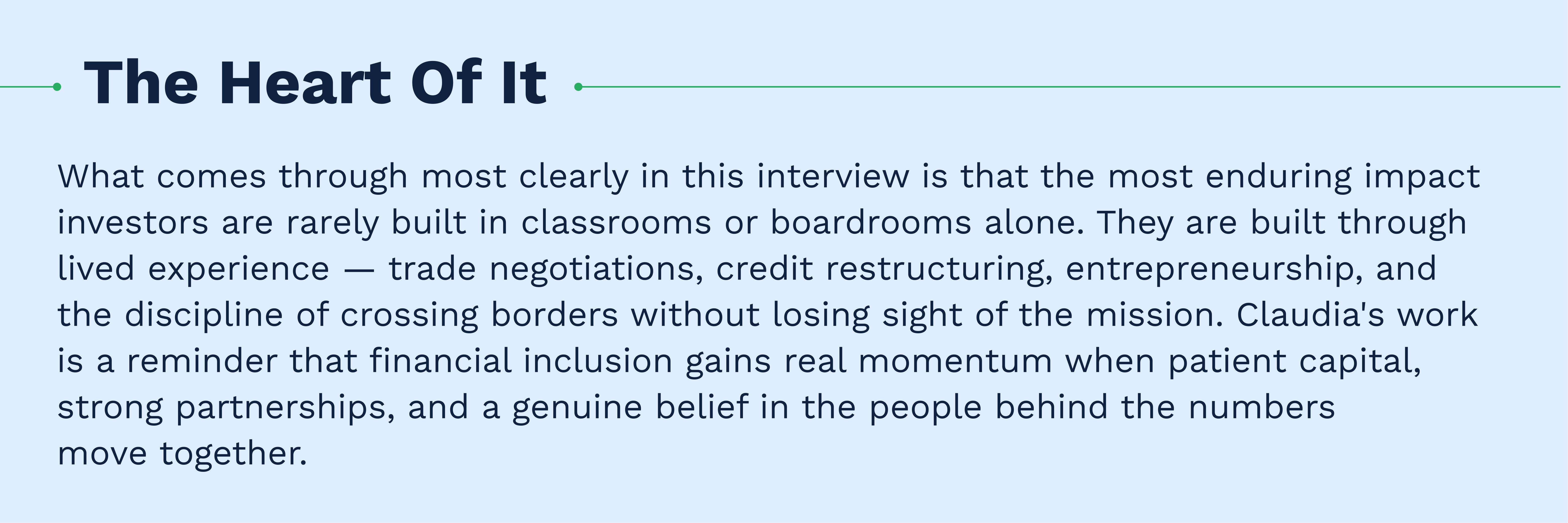
Claudia’s journey is a reminder that meaningful financial inclusion is rarely built through capital alone. It takes patience, local understanding, strong partnerships, and a willingness to look beyond the balance sheet — at the people, markets, and missions behind each institution.
As SIMPL continues to expand across emerging markets, Claudia’s work reflects a steady belief that finance can be both rigorous and purpose-driven. From Latin America to Southeast Asia, her path shows how disciplined investing, patient capital, and local partnerships can help widen access to opportunity for those still underserved by traditional finance.
References: https://www.golomtbank.com/en/news/46516, https://www.linkedin.com/in/claudia-rojas-390a9435/, https://saison-international.com/saison-investment-management



Investment involves risk. Past performance is not necessarily a guide to future performance or returns. The value of investments and the income from them can go down as well as up, and you may not get the full amount you invested. Rates of exchange may cause the value of investments to go up or down.
Any forward-looking statements, prediction, projection or forecast on the economy, stock market, bond market or economic trends of the markets contained in this material are subject to market influences and contingent upon matters outside the control of Helicap Pte. Ltd. (“Helicap”) and therefore may not be realised in the future. Further, any opinion or estimate is made on a general basis and subject to change without notice. In presenting the information above, none of Helicap, its affiliates, directors, employees, representatives or agents have given any consideration to, nor have made any investigation of the objective, financial situation or particular need of any user, reader, any specific person or group of persons. Therefore, no representation is made as to the completeness and adequacy of the information to make an informed decision. You should carefully consider (i) whether any investment views and products/ services are appropriate in view of your investment experience, objectives, financial resources and relevant circumstances. You may also wish to seek financial advice through a financial advisor or and independent legal, accounting, regulatory or tax advice, as appropriate.