Keep up with the latest FinTech and private market news, business tips, and thought leadership from industry leaders, mentors, and professionals.
Join our mailing list to receive information on upcoming Helicap platform updates and webinars.

If you're excited about the potential of private markets and fintech, we've got a job for you.
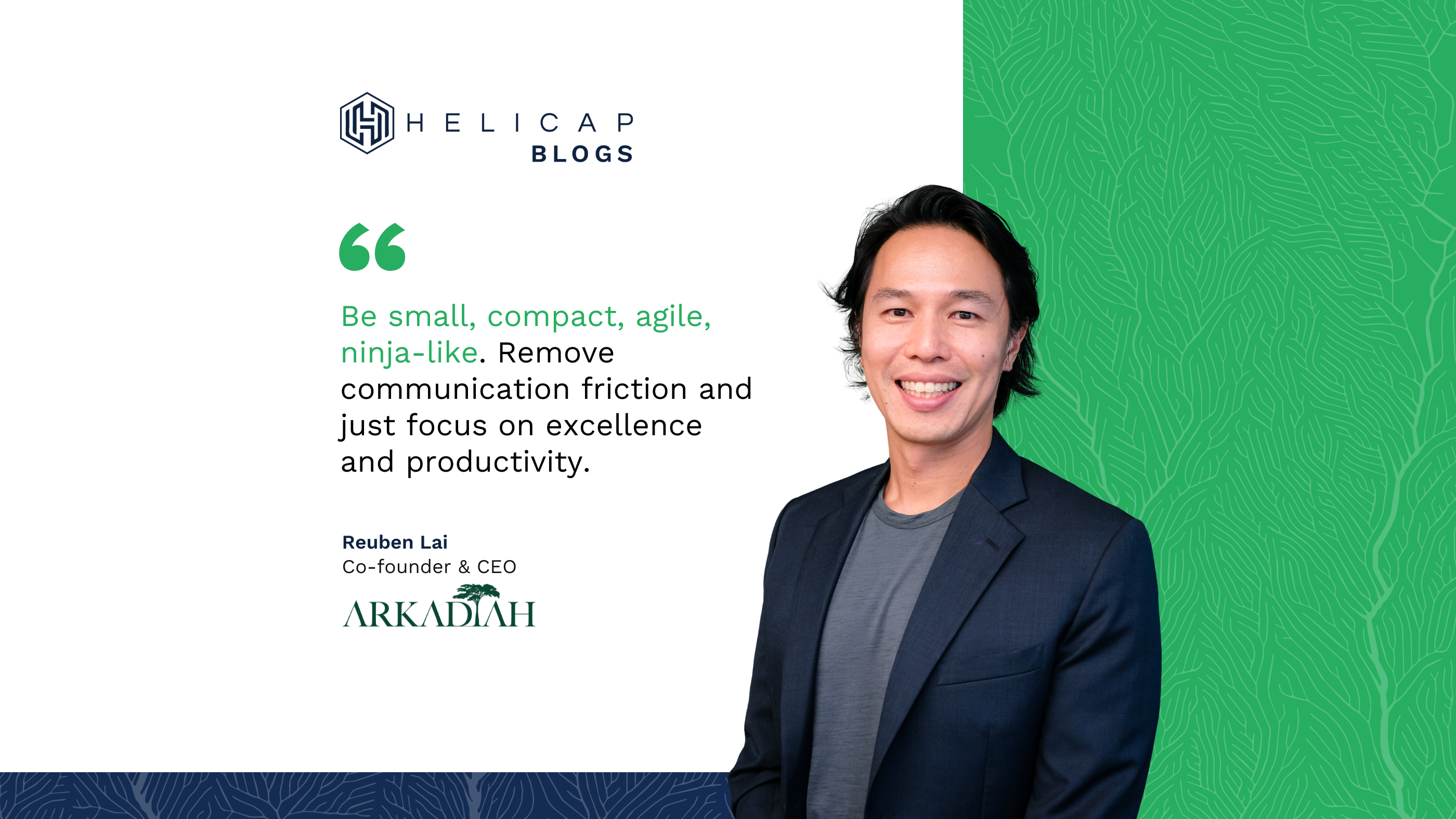
We are honoured to close the Beyond the Balance Sheet for 2025 with a defining story, proving that impact is not about size but intent. Despite a schedule that rarely slows, Reuben Lai carved out time to share his journey with us, speaking from a quiet corner amidst the bustle of the streets of Japan. The intention behind that moment says much about him.
Reuben’s career has been defined by building systems that change how people live and access opportunity. At Grab Financial Group, he helped build one of Southeast Asia’s leading fintech powerhouses, shaping payments, lending, insurance, and wealth solutions. At GXS Bank, he led regional growth and technology strategy, guiding the bank’s expansion and securing digital licences in Singapore and Malaysia. Earlier chapters at Bain & Company and The Walt Disney Company helped honed his strategic discipline and creative outlook, while his MBA from INSEAD has deepened a global perspective that continues to shape how he leads today.
Where he once built the digital rails of the region, he now dedicates his work to renewing landscapes and the lives intertwined with them through Arkadiah, a company he co-founded. This edition takes a distinct approach, combining conversation with thoughtful written narrative to capture the depth of the exchange with clarity. When Helicap CEO and Co-Founder David Z Wang sat down with Reuben, the conversation unfolded with conviction.
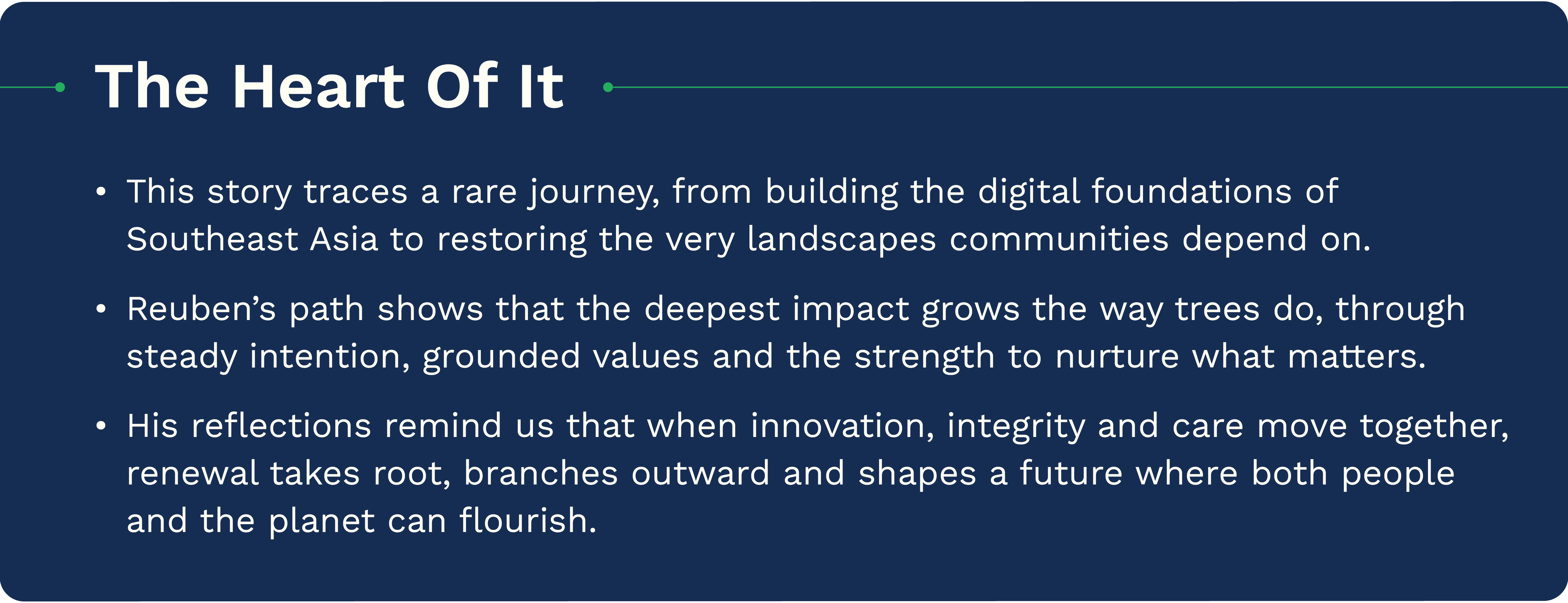
When Reuben Lai stepped away from the boardrooms of billion-dollar fintechs to co-found Arkadiah, a nature-tech company restoring degraded lands, it was not a pivot. It was a continuation of a journey that had always been grounded with purpose.
In their conversation, David begins with a reflective observation “You have had quite an illustrious and multifaceted career,” he says. “From Disney to Bain to Grab, and now your own startup. Out of these, what are the values or motivations that have consistently guided your choices?”
Reuben smiles. “If I look back, what has consistently featured in the choices I have made is the ability to create impact,” Reuben’s path has long been sharpened by the belief that business can uplift lives at scale. His early corporate roles, followed by years leading high-growth ventures, reflected that innovation should strengthen the foundations people depend on.
Today, that commitment carries him into a new frontier. With Arkadiah, he is applying the discipline of tech innovation to the regeneration of nature. “At Grab, it was about enabling millions to earn a living,” he says. “At Arkadiah, it is about aligning business with outcomes that sustain life for generations.”
Arkadiah began with a simple yet powerful idea that technology guided by care can help nature find its rhythm again. Through Light Detection and Ranging (LiDAR) scans, drones and satellite imagery, entire landscapes once dismissed as barren are being reimagined in digital form before being brought back to life. Each thread of data becomes a layer of hope, mapping the pulse of soil, tracing water lines, and measuring carbon drawn back into the earth.
Reuben and his team use these tools to bring accuracy and integrity to restoration. By combining LiDAR with satellite data, they can see how trees grow, how carbon is captured, and how the land slowly heals. This precision builds trust in the carbon markets Arkadiah supports, where every tree becomes a measurable contribution and each forest a clear reflection of recovery, restoring once-degraded land into healthy, balanced ecosystems.
At the heart of this mission lies a belief that reforestation and agriculture can thrive together. Arkadiah’s approach blends both, planting trees while cultivating crops sustaining communities. The result is not merely restored land but a living network where community and biodiversity grow together and coexist in balance.
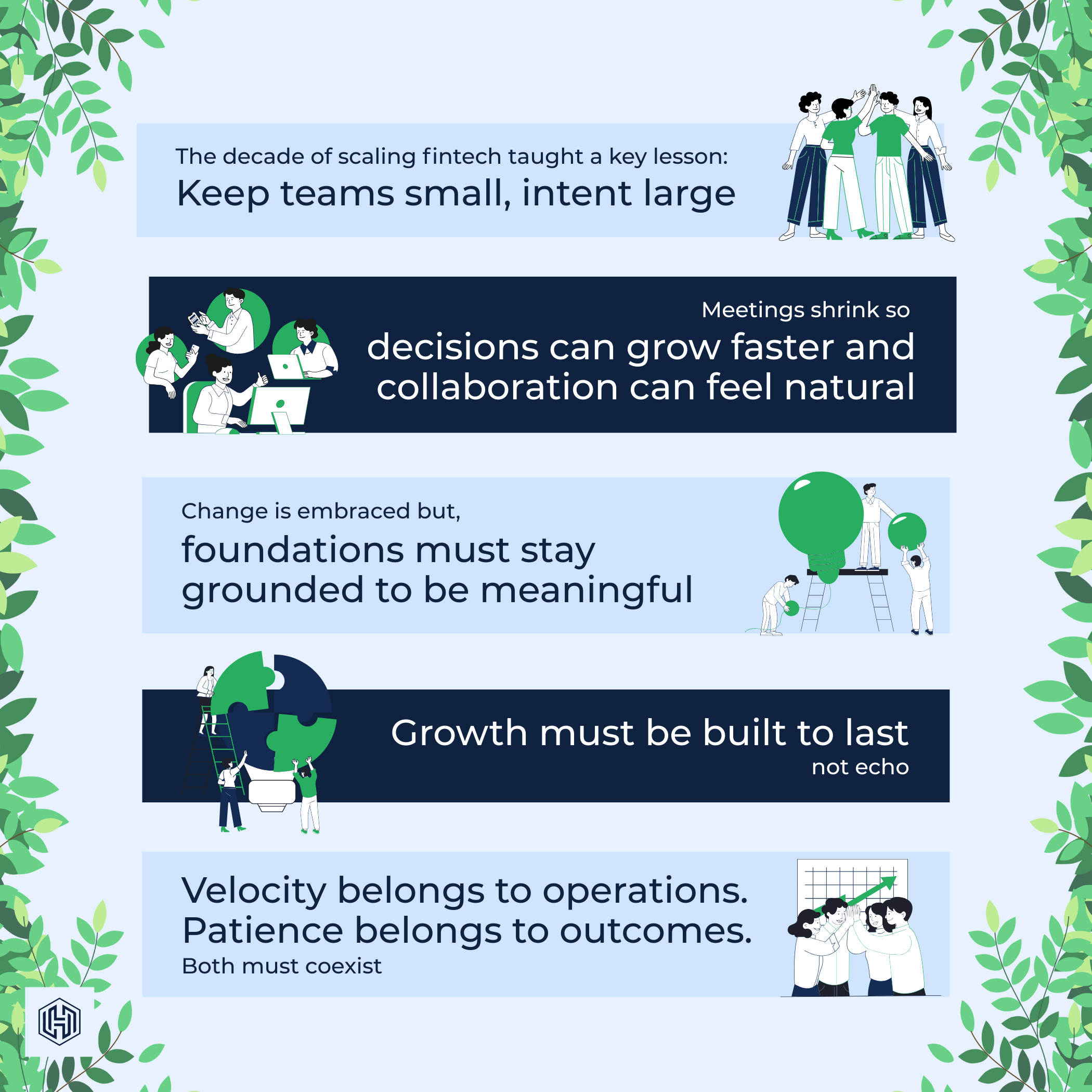
Reuben's tenure at Grab was during a defining period for Southeast Asia’s technology landscape. Those years taught him what it means to build at scale while staying anchored to intention. That insight now shapes how he leads at Arkadiah. He prefers lean, focused teams where decisions move quickly and collaboration feels organic. “When meetings get too big, I quickly dismantle them and go back to small, focused groups,” he says with a smile.
A shared belief that meaningful progress requires discipline, patience and long-term thinking. “It is on us to show the world that great companies can be built out of Southeast Asia,” Reuben adds. “We are focused on building something credible, long-lasting and positive for the region.”
“The experience taught me to embrace change but also to stay grounded,” he says. “Every challenge and every sleepless night was a reminder that growth is only meaningful when it creates lasting value." At Arkadiah, the focus is no longer on scale or speed. It is on creating a regenerative legacy, one defined by trees taking root, land coming back to life and the possibility of renewal where little once remained.
The conversation turns to finance, a subject both Reuben and David understand deeply. They agree that meaningful climate progress cannot happen without capital flowing into projects that restore, rather than deplete the planet. Finance, he notes, is not simply a means of funding growth, it is an engine that can reshape markets and redefine what is possible. Yet true transformation, he observes, often begins with smaller players. “There is a long tail of smaller businesses that need financing too. They make up most of the world’s businesses. If we want them to create an impact, we have to fund them.”
He points to agroforestry as an example. In northern Philippines, Arkadiah is supporting a nature-positive coffee initiative with Heroica Coffee, a company partnering with local farmers to grow high-quality beans while restoring degraded land. At Heroica’s first farm in Kalinga, more than 60,000 Arabica coffee trees and 1,000 native trees have taken root, creating new jobs and improving incomes for more than 50 families. Their debut harvest was sold to Blue Bottle Coffee in the United States, a milestone that affirmed both the quality of the beans and the regenerative model behind them.
Arkadiah will measure its ecological uplift through NatureOS, helping Heroica accelerate sustainable sourcing standards and generate carbon revenue while safeguarding the future of coffee farmers and the land they depend on. David reflects that meaningful progress happens when what the market wants aligns with what the planet needs. He adds that the world’s problems are already clear and that capital has a responsibility to flow toward solutions that matter. Reuben agrees, noting that pairing both sides creates momentum that can begin small and grow steadily. They shared a sense of optimism, viewing finance not as a constraint but as a catalyst that, when wisely directed, becomes a conduit for regeneration.
Whether in technology, finance or nature, he believes that meaningful change begins small, with action taken consistently over time. Each project, each restored landscape, is a seed that grows into something greater. “Start with one project, one seed, one act that makes a difference.” he says.
At Arkadiah, that philosophy has found its truest form. The company’s mission reflects his conviction that technology and integrity can move in step. “We already have the tools to accelerate our way out of the crisis,” he notes. “What we need now is to use them with humility and integrity.” For Reuben, success is measured by the legacy left in the landscape and in the lives shaped along the way
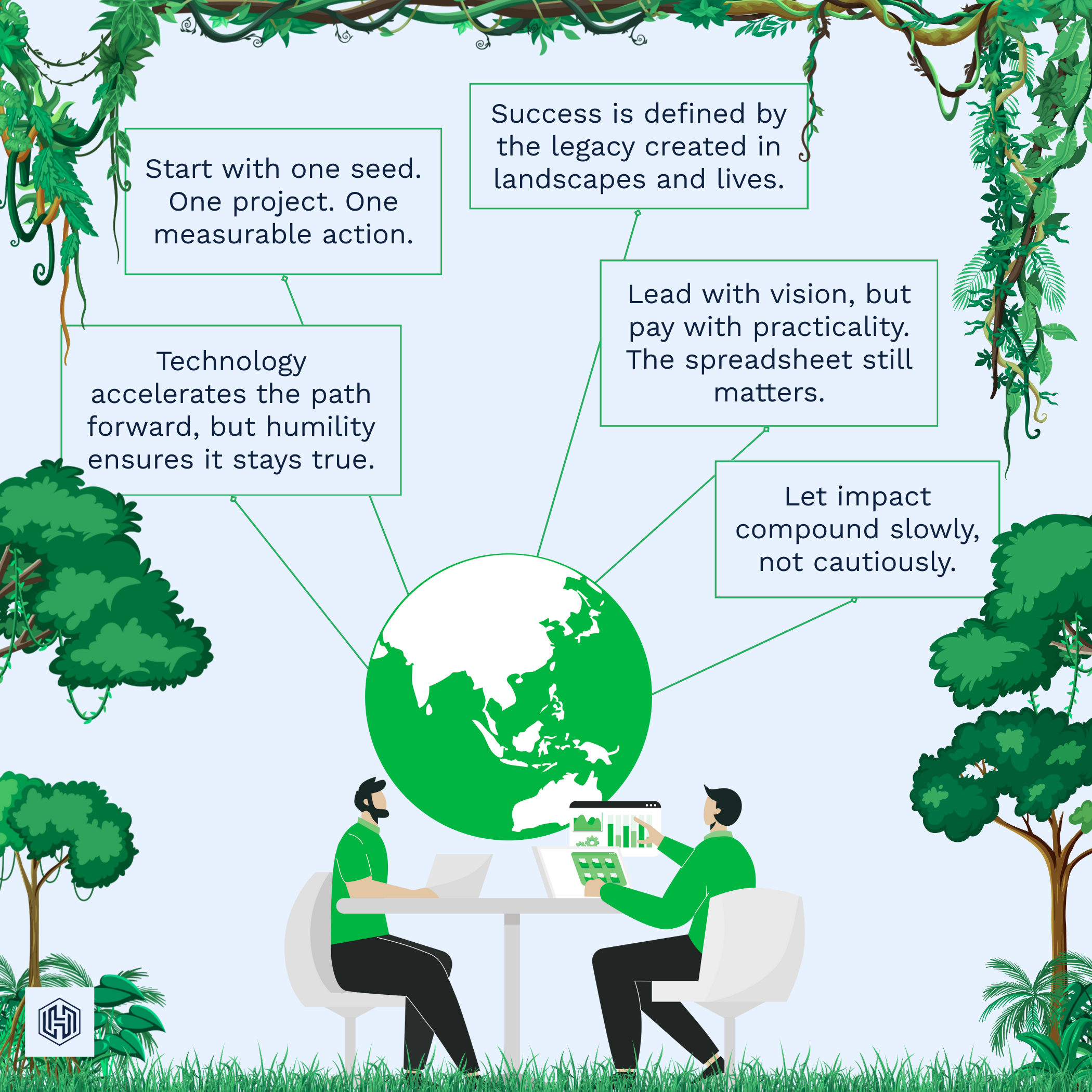
After the interview, he continued to reflect in writing, offering thoughts shaped by years of building and beginning again. These words add a more personal layer to the journey he shared, showing a leader willing to dig deeper, stay present and let his perspective take root in ways that feel both intimate and enduring.
Reuben’s story reminds us that real leadership asks for patience, clarity and the courage to nurture what others may overlook. His journey shows that when we plant our efforts in the right soil, change grows quietly but powerfully, reaching further than we ever expect.
As the year ahead draws near, may this final feature of 2025 remind us that impact holds equal value, whether the work is big or small.
.png)
.png)

Investment involves risk. Past performance is not necessarily a guide to future performance or returns. The value of investments and the income from them can go down as well as up, and you may not get the full amount you invested. Rates of exchange may cause the value of investments to go up or down.
Any forward-looking statements, prediction, projection or forecast on the economy, stock market, bond market or economic trends of the markets contained in this material are subject to market influences and contingent upon matters outside the control of Helicap Pte. Ltd. (“Helicap”) and therefore may not be realised in the future. Further, any opinion or estimate is made on a general basis and subject to change without notice. In presenting the information above, none of Helicap, its affiliates, directors, employees, representatives or agents have given any consideration to, nor have made any investigation of the objective, financial situation or particular need of any user, reader, any specific person or group of persons. Therefore, no representation is made as to the completeness and adequacy of the information to make an informed decision. You should carefully consider (i) whether any investment views and products/ services are appropriate in view of your investment experience, objectives, financial resources and relevant circumstances. You may also wish to seek financial advice through a financial advisor or and independent legal, accounting, regulatory or tax advice, as appropriate.