Keep up with the latest FinTech and private market news, business tips, and thought leadership from industry leaders, mentors, and professionals.
Join our mailing list to receive information on upcoming Helicap platform updates and webinars.

If you're excited about the potential of private markets and fintech, we've got a job for you.
IMPORTANT NOTICE: This article is for general informational purposes only and does not constitute financial advice, a recommendation, an offer, or a solicitation to invest in any financial product. Any investment products referenced are offered only to verified Accredited Investors and Institutional Investors (each as defined in Section 4A of the Securities and Futures Act 2001). Dealing services are provided by Helicap Securities Pte. Ltd., and fund products are managed by Helicap Investments Pte. Ltd. If you are not an Accredited Investor or Institutional Investor, the investment products referenced in this article are not available to you. All investments carry risk, including the possible loss of principal. Past performance is not indicative of future results.
An accredited investor in Singapore is defined under the Securities and Futures Act 2001, administered by the Monetary Authority of Singapore (MAS), as an individual or entity that meets specific financial thresholds. This status is determined solely by financial eligibility criteria, specifically income, net financial assets, or net personal assets. Investors who meet these thresholds are treated differently from retail investors, who are entitled to a higher level of regulatory protection by default. Understanding what this status means is the starting point for any informed conversation about private market investing in Singapore.
The classification of an investor as accredited or retail governs the range of investment products that may be offered to them, the extent of regulatory disclosure they are entitled to receive, and the measure of personal responsibility they are deemed to assume.
For investors who meet the eligibility criteria and elect to opt in, the consequences extend across the following key areas:
To qualify as an accredited investor under MAS guidelines, individuals and corporate entities must meet specific financial thresholds. These criteria are defined under the Securities and Futures Act and serve as the basis for determining eligibility across Singapore's private investment markets.
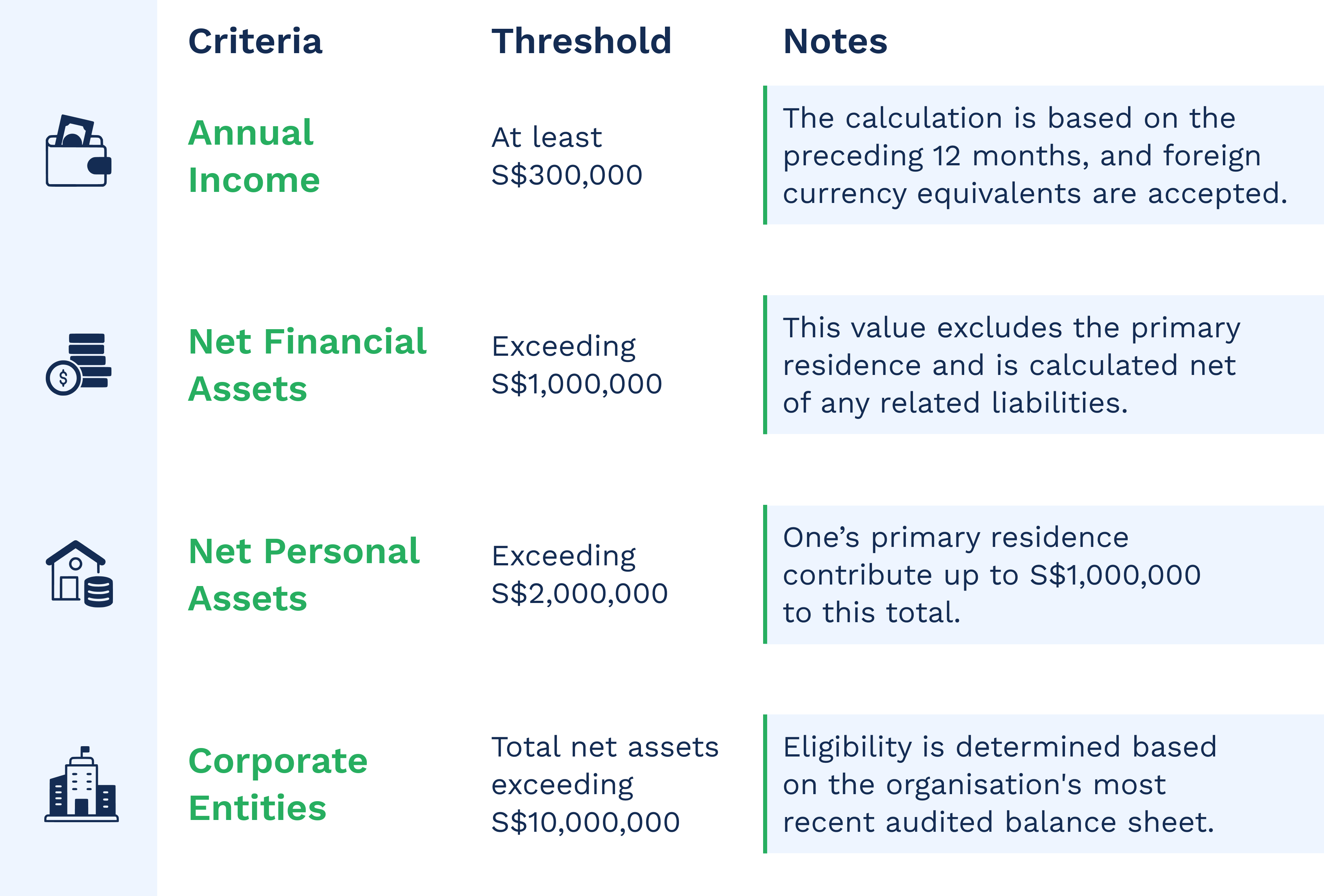
To qualify as an individual accredited investor under MAS guidelines, an investor must meet at least one of the following criteria:
Corporate entities may also qualify as accredited investors if their total net assets exceed S$10 million on their most recent audited balance sheet. Alternatively, a corporation may also qualify if it is wholly owned by accredited investors, regardless of its total net assets.
Since 2019, Singapore has operated under an opt-in regime. Meeting the financial criteria alone does not confer accredited investor status; eligible investors must explicitly consent to be treated as such by the relevant financial institution.
For those looking to understand how to become an accredited investor in Singapore, meeting one of the above thresholds is the first step, followed by formally opting in with the relevant financial institution.
Accredited investors gain access to a broader range of investment products, the ability to construct more diversified portfolios, and exposure to asset classes that may offer returns with lower correlation to public market movements.
Each of these benefits is explored below.
Access to private market opportunities is a key benefit of accredited investor status in Singapore. Unlike retail investors, who are limited to regulated retail investment products, accredited investors can participate in private placements, pre-IPO transactions, and direct lending arrangements that sit outside the scope of standard exchange-traded markets.
Private markets have a structurally different risk and return profile from public markets. Because these investments are not typically subject to daily public market pricing, they may exhibit lower correlation to listed equities. However, they also carry risks that public market instruments generally do not, including illiquidity, limited transparency, and longer investment horizons. They provide access to asset classes such as private equity, venture capital, and private credit, which are not accessible to retail investors.
For investors seeking income exposure, private credit in particular has grown in relevance. According to the Alternative Credit Council's Private Credit in Asia 2.0 report (2025), the Asia Pacific private credit market is projected to grow from USD 59 billion in 2024 to USD 92 billion by 2027, a compound annual growth rate of 16 percent.
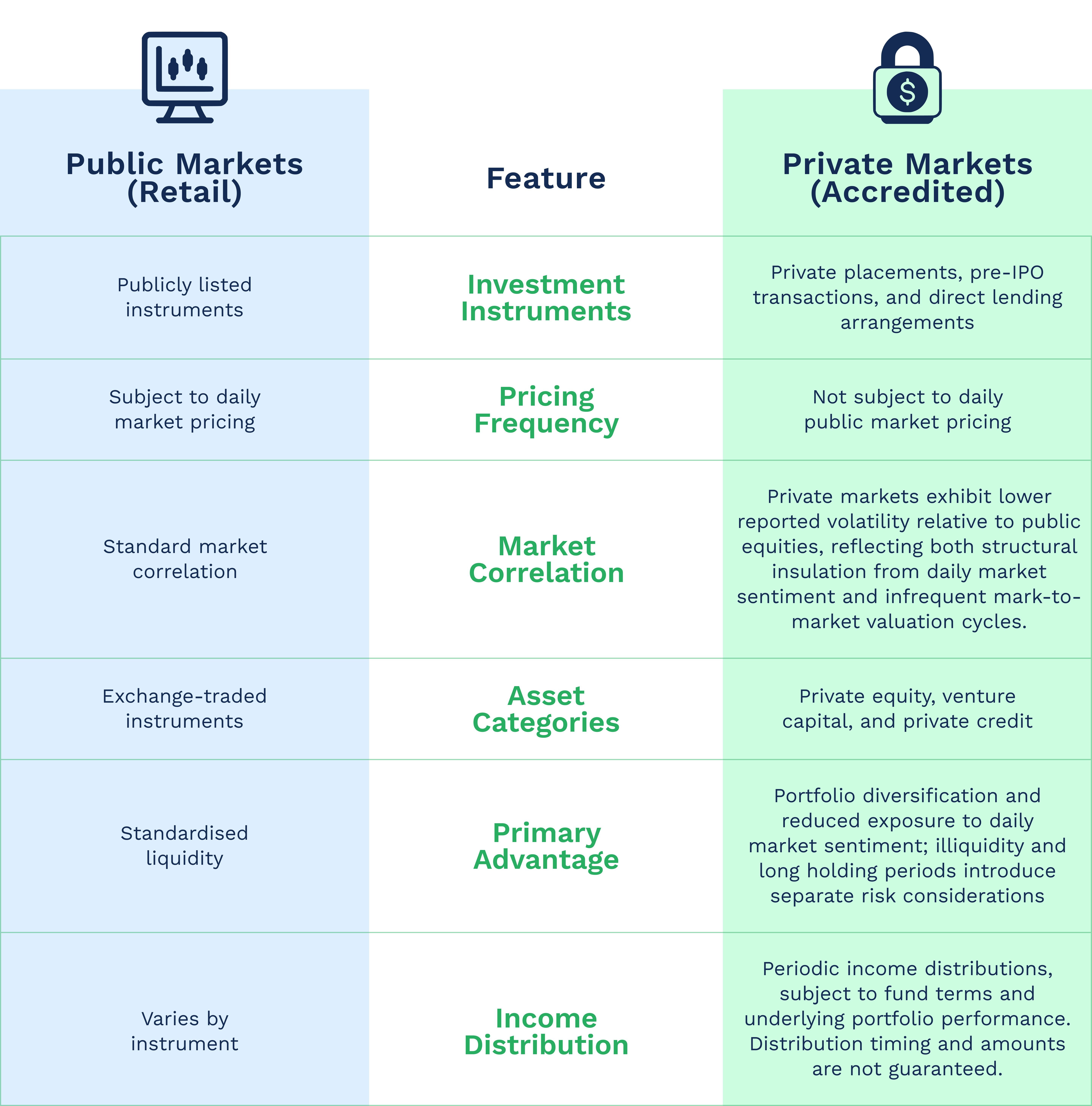
Note: Comparison based on the accredited investor framework under the Securities and Futures Act 2001 and the characteristics of private assets set out in the IMF Global Financial Stability Report (April 2024, Chapter 2). See references for full citations.
Distributions are targeted and subject to fund terms and conditions. Past performance is not indicative of future performance. Investment involves risk.
Accredited investors in Singapore can invest across a wider spectrum of asset classes than retail investors, spanning both traditional public market instruments and a range of alternative investments.
Accredited investors retain full access to the same regulated public market instruments available to retail investors. This includes publicly listed equities, exchange-traded funds (ETFs) tracking specific indices, and actively managed unit trusts and mutual funds. These instruments remain a core component of many accredited investor portfolios, providing liquidity and market exposure alongside less liquid alternative holdings.
Alternative investments are a range of asset classes not accessible to retail investors, such as:
Accredited investors in Singapore can allocate capital across several private market asset classes that retail investors cannot access, each with a distinct risk, return, and liquidity profile:
Each of these carries risks including illiquidity, concentration, and the potential loss of capital. Investors should review fund terms and seek independent advice before committing capital.
Private credit has become one of the more prominent alternative asset classes available to accredited investors in Singapore, offering income-focused returns alongside a structurally different risk profile from public market instruments.
Private credit investing involves providing debt financing directly to companies or financial institutions, rather than purchasing their publicly traded equity or bonds. Returns are generated primarily through interest payments over the life of the loan, rather than through capital appreciation.
Private credit transactions are negotiated directly between lender and borrower. This allows the terms, including pricing, covenants, security, and tenor, to be structured with a degree of precision that public debt markets generally do not permit.
According to the Alternative Investment Management Association's Private Credit in Asia 2.0 report (2025), private credit has historically been associated with institutional allocators such as pension funds and endowments, and the growth of specialist platforms has progressively broadened access through pooled fund structures and direct deal participation.
Diversified private credit funds pool capital from multiple investors and deploy it across a portfolio of private lending opportunities. The fund manager diversifies the portfolio across various originators, lending segments, and geographic regions, rather than focusing exposure on a single borrower or transaction. This strategy mitigates the potential impact of any single credit event on the portfolio's overall performance.
For accredited investors seeking income without the burden of deal-by-deal selection, a diversified private credit fund offers a managed approach to the asset class.
Senior secured lending is a foundational risk management tool in private credit. Loans structured on a senior secured basis sit at the top of the borrower's capital structure, meaning that in the event of default or insolvency, senior secured lenders have the first claim on the borrower's assets ahead of subordinated creditors and equity holders.
A senior secured loan may include physical assets, receivables, or other forms of collateral, depending on the borrower's profile and the terms negotiated at origination. This structural protection does not eliminate credit risk, but it materially improves the lender's recovery position relative to unsecured or subordinated lending.
S&P Global's long-term US recovery data from 1987 to 2023, for instance, show senior secured bonds recovering an average of 58.1%, compared with 44.8% for unsecured bonds.
The risk framework is reinforced through disciplined deal structuring, including strong covenant packages that enable early intervention if a borrower's financial situation worsens.
Private credit is primarily an income-focused asset class. Returns are generated through the regular interest payments made by borrowing companies over the life of the loan, rather than through market price appreciation.
This income profile depends on the credit performance of the underlying borrowers. If borrowers default or credit quality deteriorates, income and capital can be affected, and returns are not guaranteed.
Most private credit facilities carry floating interest rates, meaning the coupon adjusts in line with benchmark rates. As the Bank for International Settlements notes, direct lending consists predominantly of floating-rate loans, so lenders' interest income rises when benchmark rates rise. That same feature also raises borrowers' costs, however, which can increase default risk when rates rise, so higher coupons do not translate directly into higher net returns.
For investors seeking income such as quarterly distributions, private credit funds are structured to pass through interest income to investors on a defined schedule, subject to the fund's terms and conditions.
Beyond pooled fund structures, accredited investors may also access private credit through direct deal participation. This approach places greater responsibility on the investor but offers a correspondingly higher degree of control over portfolio composition and specific credit exposures.
Deal-by-deal investment opportunities allow accredited investors to evaluate and select individual private credit transactions on a case-by-case basis. The investor independently evaluates each opportunity, examining the deal's structure, the borrower's profile, the collateral package, the pricing, and the tenor before committing to participation.
This approach is well-suited to investors who have a defined view on specific sectors, geographies, or borrower types and who prefer to construct their private credit exposure selectively rather than through a pooled allocation. It typically requires more active involvement in due diligence and carries a higher degree of concentration risk per position compared to a diversified fund.
Accredited investors in Singapore access private market investments through a range of channels, from specialist fund platforms to direct deal structures. The right access point depends on the investor's preferred level of involvement, minimum capital commitment, and appetite for portfolio concentration versus diversification.
Alternative investment funds provide accredited investors with a managed entry point into private markets. These pooled investment vehicles, such as private equity, private credit, and real asset funds, offer investors diversified exposure to a specific strategy. This structure eliminates the need for investors to individually assess each transaction. The fund manager handles origination, structuring, due diligence, and ongoing monitoring on behalf of investors.
This channel is particularly relevant for accredited investors who are new to private markets or who prefer a less hands-on approach. Investors should review minimum investment thresholds, committed capital periods, and liquidity terms carefully before committing capital, as these vary by fund.
Private credit investment platforms provide accredited investors with direct access to private lending opportunities, typically through a digital interface that supports deal discovery, documentation review, and post-investment monitoring.
These platforms sit between the investor and the underlying borrower or originator, handling much of the operational infrastructure required to participate in private credit markets.
An accredited investor in Singapore is an individual or entity that meets specific financial thresholds set by the Monetary Authority of Singapore (MAS).
To be recognised as an accredited investor in Singapore, individuals must meet at least one of the following financial thresholds set by the Monetary Authority of Singapore (MAS): an annual income of at least S$300,000 in the preceding 12 months; net financial assets exceeding S$1 million, excluding the primary residence and net of any related liabilities; or net personal assets exceeding S$2 million, where the net value of the primary residence is capped at S$1 million toward this total. They must also formally opt in to this status with their financial institution.
Accredited investors in Singapore can access private equity, venture capital, hedge funds, private credit, structured products, and pre-IPO opportunities, in addition to standard public market instruments available to retail investors.
Accredited investors gain access to private market assets, such as private credit, private equity, and hedge funds, which are unavailable to retail investors. These assets offer distinct return and diversification benefits.
Yes, accredited investors in Singapore can invest in private credit through diversified fund structures or direct deal participation, with returns generated primarily through interest payments on senior secured loans.
To become an accredited investor in Singapore, an eligible individual must meet at least one MAS financial threshold and explicitly consent to opt in to accredited investor status through their financial institution.
This article is for general informational purposes only and does not constitute financial advice, a recommendation, an offer, or a solicitation to invest in any financial product. Any investment product referenced is offered only to verified Accredited Investors and Institutional Investors (each as defined in Section 4A under the Securities and Futures Act 2001). If you are not an Accredited Investor or Institutional Investor, the investment products referenced in this article are not available to you. All investments carry risk, including the possible loss of principal. Past performance is not indicative of future results.


Investment involves risk. Past performance is not necessarily a guide to future performance or returns. The value of investments and the income from them can go down as well as up, and you may not get the full amount you invested. Rates of exchange may cause the value of investments to go up or down.
Any forward-looking statements, prediction, projection or forecast on the economy, stock market, bond market or economic trends of the markets contained in this material are subject to market influences and contingent upon matters outside the control of Helicap Pte. Ltd. (“Helicap”) and therefore may not be realised in the future. Further, any opinion or estimate is made on a general basis and subject to change without notice. In presenting the information above, none of Helicap, its affiliates, directors, employees, representatives or agents have given any consideration to, nor have made any investigation of the objective, financial situation or particular need of any user, reader, any specific person or group of persons. Therefore, no representation is made as to the completeness and adequacy of the information to make an informed decision. You should carefully consider (i) whether any investment views and products/ services are appropriate in view of your investment experience, objectives, financial resources and relevant circumstances. You may also wish to seek financial advice through a financial advisor or and independent legal, accounting, regulatory or tax advice, as appropriate.