Keep up with the latest FinTech and private market news, business tips, and thought leadership from industry leaders, mentors, and professionals.
Join our mailing list to receive information on upcoming Helicap platform updates and webinars.

If you're excited about the potential of private markets and fintech, we've got a job for you.
IMPORTANT NOTICE: This article is for general informational purposes only and does not constitute financial advice, a recommendation, an offer, or a solicitation to invest in any financial product. Any investment products referenced are offered only to verified Accredited Investors and Institutional Investors (each as defined in Section 4A of the Securities and Futures Act 2001). Dealing services are provided by Helicap Securities Pte. Ltd., and fund products are managed by Helicap Investments Pte. Ltd. If you are not an Accredited Investor or Institutional Investor, the investment products referenced in this article are not available to you. All investments carry risk, including the possible loss of principal. Past performance is not indicative of future results.
Receivables financing has become more relevant as lenders seek ways to keep capital moving without waiting for every receivable to mature. According to Growth Market Reports' 2025 industry study, the global trade receivables finance market reached approximately USD 2.69 trillion in 2025 and is projected to grow at a 9.8% CAGR through 2034 as working-capital demand intensifies across non-bank credit channels.
In the global trade finance market, receivables financing and invoice discounting account for approximately 14%. This indicates how these alternative financing instruments have become more significant for working capital strategies.
By financing eligible receivables earlier, businesses and credit platforms can unlock up to 90% of invoice value and improve balance sheet efficiency, according to NetSuite's accounts receivable financing guide.
Receivables financing is a form of secured funding in which a business or lender pledges its outstanding receivables, such as invoices, instalment loans, or card receivables, to raise capital today against expected future cash flows.
Receivable financing in lending markets refers to credit facilities where a lender or originator uses its portfolio of receivables as collateral to secure term funding or revolving lines from banks, funds, or private credit investors. Instead of waiting for each downstream borrower to repay over six, twelve, or twenty‑four months, the originator can unlock a portion of that value upfront, subject to eligibility and concentration criteria.
These facilities are commonly structured as a warehouse line, a securitisation, or a structured credit facility, according to Slaughter and May's November 2025 originator's guide to securitisation, where the receivables sit in a special purpose vehicle (SPV) and investors fund senior or mezzanine tranches against that pool.
According to the Asian Development Bank's January 2026 Global Trade Finance Gap Survey, the global trade finance gap stood at USD 2.5 trillion in 2025, representing about 10% of global trade, with Asia accounting for the largest share of unmet demand and receivables-backed instruments among the fastest-growing tools cited by surveyed banks. This uptick reflects the growing centrality of these structures in working capital and alternative credit markets.
FinTech and non‑bank lenders use receivables financing to keep lending capital working throughout the cycle. Once a receivable is created, it can serve as a financeable asset, provided the lender can evidence disciplined underwriting, clear visibility on repayments, robust portfolio data, and legal control over collections.
For non-bank lenders, receivables financing acts as a practical funding bridge between origination and final repayment. Lenders can refinance eligible receivables and channel capital back into new lending.
According to a joint 2025 study by the Cambridge Centre for Alternative Finance and the Asian Development Bank Institute, digital finance platforms have helped MSMEs across selected Asian emerging markets access funding and improve business performance, with respondents reporting an overall loan default rate of under 1. As the region's MSME base, which the World Economic Forum estimates makes up the overwhelming majority of ASEAN enterprises, continues to grow, so does the opportunity for receivables-backed lending.
Receivables financing works by separating a pool of eligible receivables from the originator's balance sheet. The funder then advances a percentage of that pool's value to the originator. As end-borrowers repay, those cash flows are used to pay down the facility.
The structure of receivables financing transactions involves the following layers:
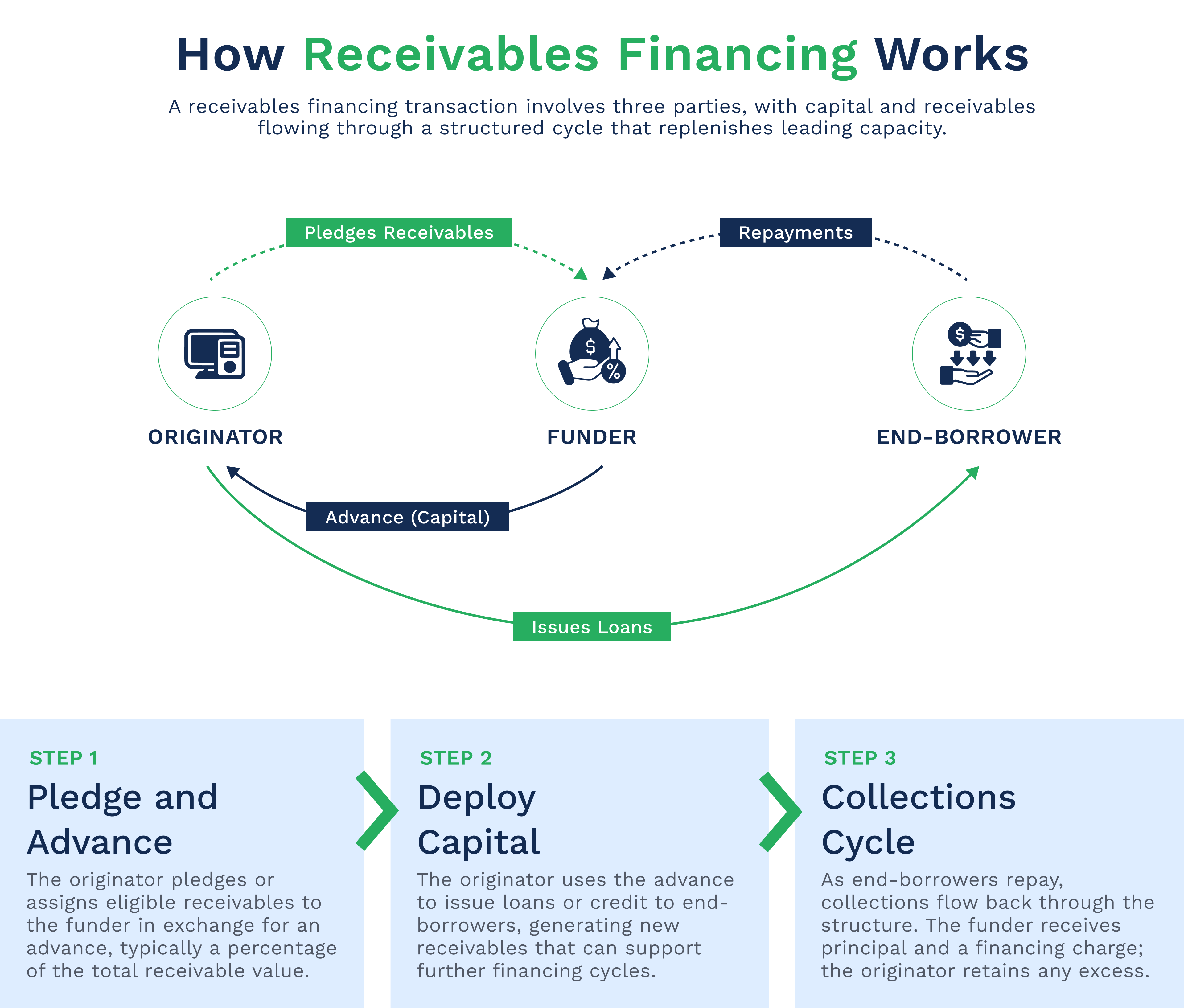
This three‑party structure shown in the above diagram is closely aligned with how forward‑flow and asset‑backed finance transactions are described, according to Weil’s 2025 analysis.
In this flow, the originator pledges or assigns eligible receivables to the funder in exchange for an advance at a percentage of the total receivable value. As end-borrowers repay, collections flow back through the structure, with the funder receiving principal and a financing charge.
In Asia, these facilities are often set up through bankruptcy‑remote SPVs that acquire receivables from the originator and issue notes or participation interests to investors, mirroring broader trade and supply chain finance structures in the region.
The cash flow cycle in receivables financing starts when the originator disburses a loan or when a corporation issues an invoice and ends when funds from the underlying borrowers or buyers are collected and passed through to repay the facility.
At each step, cash waterfalls, reserve accounts, and reporting covenants determine how much is recycled back to the originator for fresh lending. In a typical Southeast Asia FinTech transaction, end‑borrowers pay installments into a controlled account, from which servicer fees, senior interest, and principal are paid before any residual cash is released as excess spread.
This structure provides visibility into receivables-backed cash flows, including performance data, delinquency curves, and loss-given-default metrics at the pool level.
Receivables financing commonly used by FinTech and non‑bank lenders includes invoice factoring, accounts receivable financing, asset-backed receivables lending, and receivables securitisation. Factoring remains a major form of receivables finance: global factoring turnover reached €4.039 trillion in 2025, up 3.7% from €3.895 trillion in 2024, according to FCI World Factoring Statistics.
Each type allocates risk, control, and economics differently, and the right choice depends on the originator’s business model, maturity, and investor base.
Invoice factoring is a well-known form of receivable financing in which a business sells its outstanding invoices to a factor at a discount in exchange for immediate liquidity. Depending on whether the arrangement is recourse or non-recourse, the factor may assume the buyer's credit risk and typically takes over collections.
In Singapore, the invoice factoring market has gained considerable traction. According to FCI's 2025 World Factoring Statistics, Singapore is among Asia-Pacific's key factoring markets, with the region recording USD1.1 trillion in total factoring volume — a figure that has grown at a compounded annual rate of 7.8% over the past two decades. This trend highlights the depth of demand among the city-state's 220,000-plus MSMEs.
Accounts receivable financing is a broader category in which the originator uses its receivables as collateral for a revolving credit facility without selling the invoices outright. According to NetSuite's December 2025 guide, in accounts receivable loans, the business retains ownership of the receivables and remains responsible for them, whereas in factoring, the invoices are sold outright to a third party. This distinction can make the model well-suited to businesses that want to maintain customer relationships while accessing working capital.
In asset-backed receivables lending, a pool of receivables typically serves as collateral for a structured facility. Demand for digital financing among MSMEs remains significant in Asia, with a 2025 Cambridge Centre for Alternative Finance and Asian Development Bank Institute study finding that digital-finance platforms helped participating MSMEs access funding and support growth. This helps explain why fintechs and non-bank lenders may use receivables-backed facilities to fund consumer, merchant, or MSME lending beyond their own balance-sheet capacity, subject to facility terms and asset performance.
Receivables securitisation involves pooling receivables into a special purpose vehicle and issuing securities backed by cash flows from those assets. Based on Slaughter and May's November 2025 guide, this structure segregates the credit risks of a specific asset pool from the originator's own balance sheet via an SPV that purchases the receivables and issues securities to investors. It is the most complex form and typically more common in larger markets, but highlights how receivables can underpin structures ranging from straightforward invoice funding to institutional capital markets solutions.
Invoice factoring and receivables financing both convert future cash flows into present liquidity, but they differ in ownership, transparency, and strategic fit for FinTech lenders.
The table below shows the main differences between invoice factoring and receivables financing.
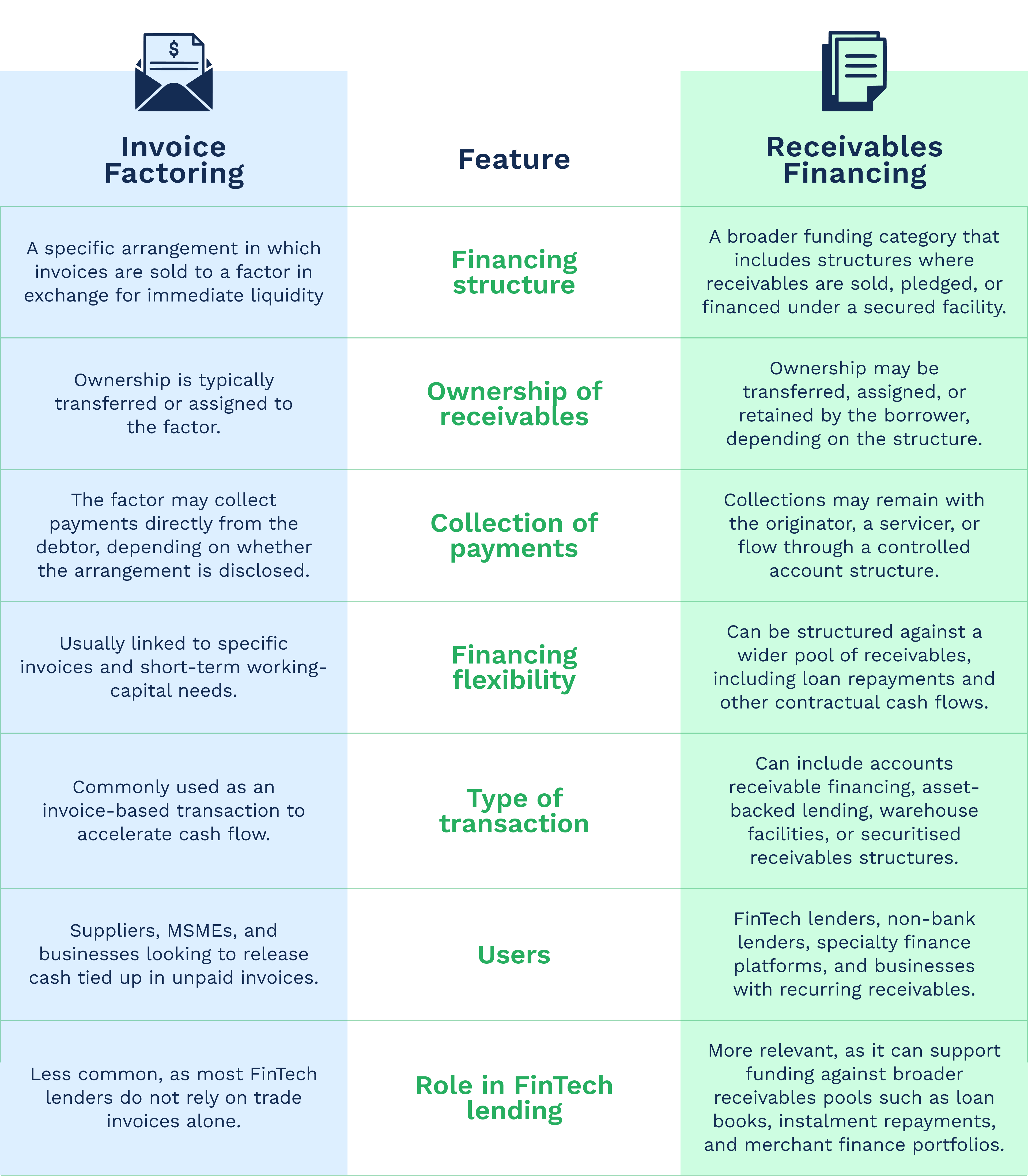
For private credit investors, receivables financing may offer significant advantages for FinTech companies and non-bank lenders. It may allow funding to be aligned with the performance of the underlying assets, enhance capital efficiency, and improve risk transparency for investors.
When structured effectively, it potentially creates a positive cycle in which origination, funding, and risk management support and strengthen one another.
For originators, receivables financing may:
For private credit investors, receivables financing may offer:
Investments in private credit and alternative lending instruments carry risks including borrower default risk, illiquidity risk, concentration risk, and currency risk. Returns are not guaranteed. Investors may lose part or all of their capital. Past performance is not indicative of future results.
Receivables financing for FinTech and non‑bank lenders can serve as a key funding channel behind many of Southeast Asia's digital credit and embedded finance models. According to the World Economic Forum's October 2025 analysis of ASEAN's SME digital financing gap, private credit and fintech-originated lending complement one another to serve the region's "missing middle" of underbanked SMEs. Without it, originators may either grow slowly on their own equity or take on unstable leverage that does not withstand stress.
FinTech lenders generate receivables through their core lending activities: consumer instalment platforms create a receivable every time they issue a loan, MSME lenders generate receivables from working capital facilities, and Buy Now Pay Later (BNPL) providers create receivables from each instalment plan. The volume, granularity, and data richness of these receivables make them well-suited to receivables financing structures. According to the CFPB's December 2025 BNPL Market Report, the rapid scaling of short-duration instalment receivables across digital lending platforms reinforces how the volume, granularity, and data richness of these receivables make them well-suited to receivables financing structures.
Data and credit analytics may be used by funders and private credit investors to assess creditworthiness. The metrics used are usually based on historical performance data, including default rates, delinquency curves, recovery rates, and borrower demographics.
According to the World Bank Group's 2024 report on alternative data in credit risk assessment, integrating invoice and transaction data into underwriting models can enhance the predictive capability of traditional credit assessments by 5 to 20 percent, improving approval rates and reducing credit losses for previously underserved borrowers.
Platforms that demonstrate consistent underwriting discipline, clean data infrastructure, and transparent reporting are usually better positioned to attract institutional capital across Singapore and Southeast Asia. In McKinsey’s 2026 Global Private Markets Report, it was found that 35% of limited partners ranked clean data analytics and reporting among the top attributes they seek in fund managers.
Receivables financing in Singapore has expanded alongside broader private credit growth across the region, supported by growing trade flows, MSME digitisation, and FinTech lending models that serve underserved segments.
The Asian Development Bank estimates the global trade finance gap at USD 2.5 trillion, with Asia accounting for the largest share. In Singapore, small and medium-sized enterprises numbered 369,500 in 2025, compared with 371,000 enterprises overall, according to the Singapore Department of Statistics.
SMEs may require external working-capital finance to manage operating cash flows, including through the Enterprise Financing Scheme, SME Working Capital Loan, which supports eligible firms’ operational cash-flow needs.
Singapore acts as a hub for Asia’s private credit and receivables-backed structures. The government's SGD 1 billion Private Credit Growth Fund, announced in Budget 2025, signals growing conviction in receivables financing in Singapore.
Investors access receivables financing through different structures, depending on ticket size, risk appetite, reporting needs, and whether they prefer pooled or deal-by-deal exposure.
Investors can access receivables financing through structured credit vehicles, where pools of receivables are packaged into tranched products with defined risk-return profiles. According to KBRA's January 2026 Private Credit Outlook, the sector is expected to see rising complexity in 2026 as asset-based finance collateral, fund finance transactions, and rated note feeder structures expand across the private credit landscape.
Direct receivables-backed lending involves investors funding specific originators' portfolios through bilateral or club-deal facilities. This approach provides deal-level transparency and allows investors to conduct due diligence on the originator's underwriting and collection performance.
Private credit investment platforms curate portfolios of receivables-backed deals, providing diversified exposure across originators, geographies, and asset types. According to Preqin's 2025 Global Report: Private Debt Chambers and Partners, private credit generated a 6.9% return in 2024, exceeding private equity at 5.6%, and the asset class continues to attract capital from sovereign wealth and pension funds.
Investments in private credit and alternative lending instruments carry risks including borrower default risk, illiquidity risk, concentration risk, and currency risk. Returns are not guaranteed. Investors may lose part or all of their capital. Past performance is not indicative of future results.
Receivables financing is a form of funding that uses outstanding receivables as the basis for an advance, loan, or asset purchase. The receivables may be sold, assigned, or pledged depending on the structure.
Receivables financing works by advancing capital against eligible receivables, then repaying that financing as the underlying receivables are collected. The structure usually includes advance rates, eligibility tests, and monitoring requirements.
Factoring is one type of receivables financing. In factoring, invoices are commonly sold or assigned to a factor, while broader receivables financing may also include collateralised lending, warehouse facilities, or securitised pools.
Receivable financing companies can include banks, finance companies, specialist factors, non-bank lenders, and private credit providers, depending on the market and the asset type. In Singapore, banks and other regulated financial institutions are active across working capital and invoice financing solutions.
FinTech lenders use receivables financing to free up capital tied in existing portfolios, diversify funding sources, and support new originations. The structure is most effective when the underlying receivables are data-rich, well-serviced, and transparently monitored.
Invoice factoring is a financing arrangement in which a company sells outstanding invoices to a factor at a discount in exchange for immediate cash. It is one of the most common forms of receivables financing.
This article is for general informational purposes only and does not constitute financial advice, a recommendation, an offer, or a solicitation to invest in any financial product. Any investment product referenced is offered only to verified Accredited Investors and Institutional Investors (each as defined in Section 4A under the Securities and Futures Act 2001). If you are not an Accredited Investor or Institutional Investor, the investment products referenced in this article are not available to you. All investments carry risk, including the possible loss of principal. Past performance is not indicative of future results.


Investment involves risk. Past performance is not necessarily a guide to future performance or returns. The value of investments and the income from them can go down as well as up, and you may not get the full amount you invested. Rates of exchange may cause the value of investments to go up or down.
Any forward-looking statements, prediction, projection or forecast on the economy, stock market, bond market or economic trends of the markets contained in this material are subject to market influences and contingent upon matters outside the control of Helicap Pte. Ltd. (“Helicap”) and therefore may not be realised in the future. Further, any opinion or estimate is made on a general basis and subject to change without notice. In presenting the information above, none of Helicap, its affiliates, directors, employees, representatives or agents have given any consideration to, nor have made any investigation of the objective, financial situation or particular need of any user, reader, any specific person or group of persons. Therefore, no representation is made as to the completeness and adequacy of the information to make an informed decision. You should carefully consider (i) whether any investment views and products/ services are appropriate in view of your investment experience, objectives, financial resources and relevant circumstances. You may also wish to seek financial advice through a financial advisor or and independent legal, accounting, regulatory or tax advice, as appropriate.