
Keep up with the latest FinTech and private market news, business tips, and thought leadership from industry leaders, mentors, and professionals.
Join our mailing list to receive information on upcoming Helicap platform updates and webinars.

If you're excited about the potential of private markets and fintech, we've got a job for you.
We open Helicap’s flagship Beyond the Balance Sheet series for 2026 with a story about conviction, clarity, and the discipline of building something that genuinely serves the people it was designed for.
Georg Steiger, Co-founder and CEO of Billease, came to fintech through a path of deliberate curiosity: law, then IT, an MBA from Kelley School of Business, and a tenure at McKinsey advising financial institutions across markets. That experience crystallised a belief that now defines one of the Philippines' leading consumer fintech platforms: financial services, designed with care and the right technology, can meaningfully change the arc of a household.
Drawn to the opportunity he saw in the Philippines, Georg chose to build alongside two McKinsey colleagues, Huyen Nguyen and Ritche Weekun. Together, they built Billease into a full-stack consumer credit business, attracting institutional capital from TPG's The Rise Fund, expanding its credit facility with Helicap, and most recently acquiring the Rural Bank of Sta. Maria to take deposits and close the full loop of financial inclusion.
The numbers reflect what that discipline has produced. In 2023, revenue doubled to US$57 million, net income reached US$7 million, and Billease posted a 47% return on equity against the 5 to 15% typical of traditional Philippine banks. The company has since gone further: a ₱5 billion corporate notes facility arranged by Security Bank Capital, and a banking licence through the acquisition of the Rural Bank of Sta. Maria that opens the path toward everyday savings and transactions for the customers it serves. The platform has now reached over 10 million customers and disbursed more than ₱100 billion in loans.
This edition combines conversation with written reflection to capture the depth of Georg's thinking. When Helicap's Director of Sales and Partnerships, Cheryl, sat down with him, the exchange carried the kind of considered honesty that comes from a founder who has thought carefully about every turn in the road.
The conversation opens where every compelling origin story does: with the decision to leave something familiar behind.
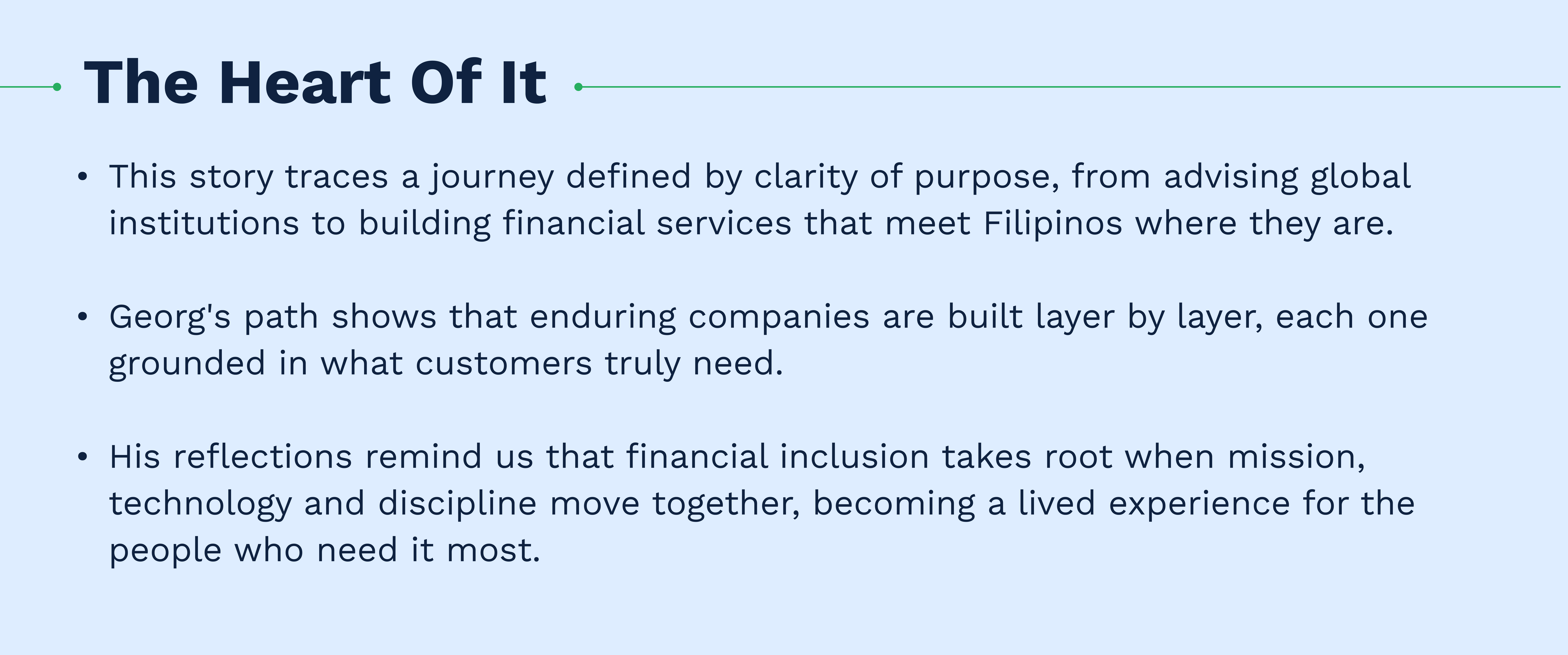
Georg describes the move from McKinsey as something he and his co-founders had been actively looking for rather than something that happened by chance. They wanted the opportunity to start and build a company from scratch, and in the Philippines, they saw a space that was very well suited to what they believed they could build.
Reflecting on the early days, Georg shares that they had identified a large opportunity in the Philippines' consumer finance market, because the banking system was serving the majority of customers poorly. Processes were manual and costly, and they required ticket sizes that simply did not fit the reality of most Filipino households. The hypothesis he and his co-founders carried into Billease was that an automated and efficient solution could successfully expand the market. A decade on, that hypothesis has held, and the company has grown around it.
On the topic of BNPL and the criticism the category often attracts globally, Georg engages directly and with the care of someone who has thought about it for a long time.
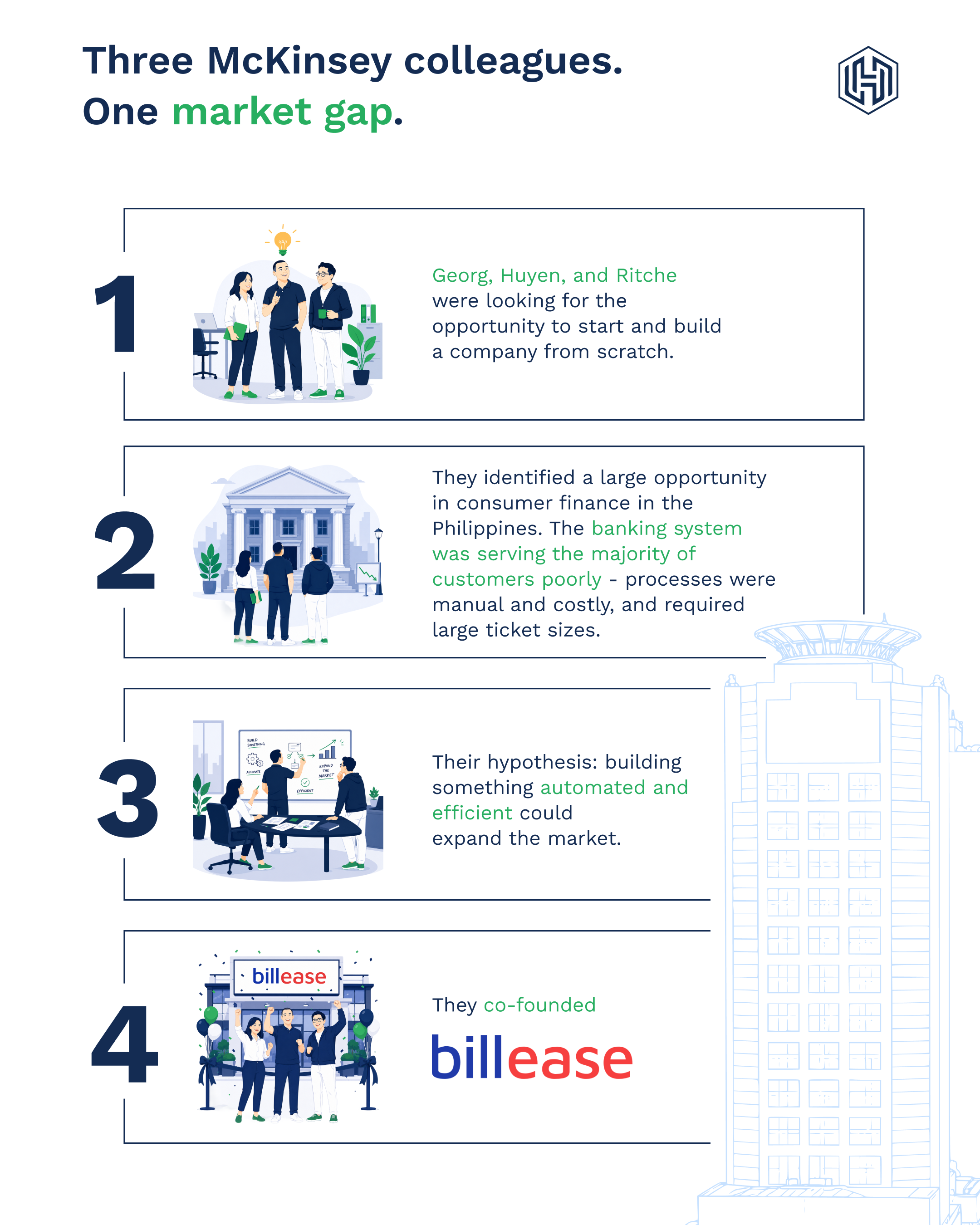
He acknowledges that consumer finance requires caution, especially when servicing customers who are new to credit, and emphasises the necessity of building a service that is fair and easy for customers to understand. He is also clear that lending itself is not the issue. “There is always a need for lending”, he notes, and providing a formal system option is preferable to customers having to rely on informal and illegal lenders.
What gives him confidence that Billease is striking the right balance is the data: 40% to 50% of the customers who joined the platform when Billease launched in 2017 are still transacting with the company today. Retention of that kind, Georg observes, is not something a company can manufacture.
Cheryl turns the conversation to Georg's personal operating rhythm at a moment when Billease is integrating a rural bank, deepening its institutional capital base, and scaling its team. His answer is characteristically grounded.
Georg stays closely involved in product and technology. He prototypes, reviews architectures, and remains hands-on with the detail. At this stage of the company, that is deliberate. In his experience, the best strategic calls are the ones shaped by a real understanding of what can actually be delivered.
He is also quick to note that he does not carry the weight alone. As one of three co-founders, the load is shared across their respective strengths, and around them sits a strong executive team, helping the organisation to execute with clarity and confidence.
Georg shares a set of reflections he often comes back to when speaking with founders earlier in their own journeys.
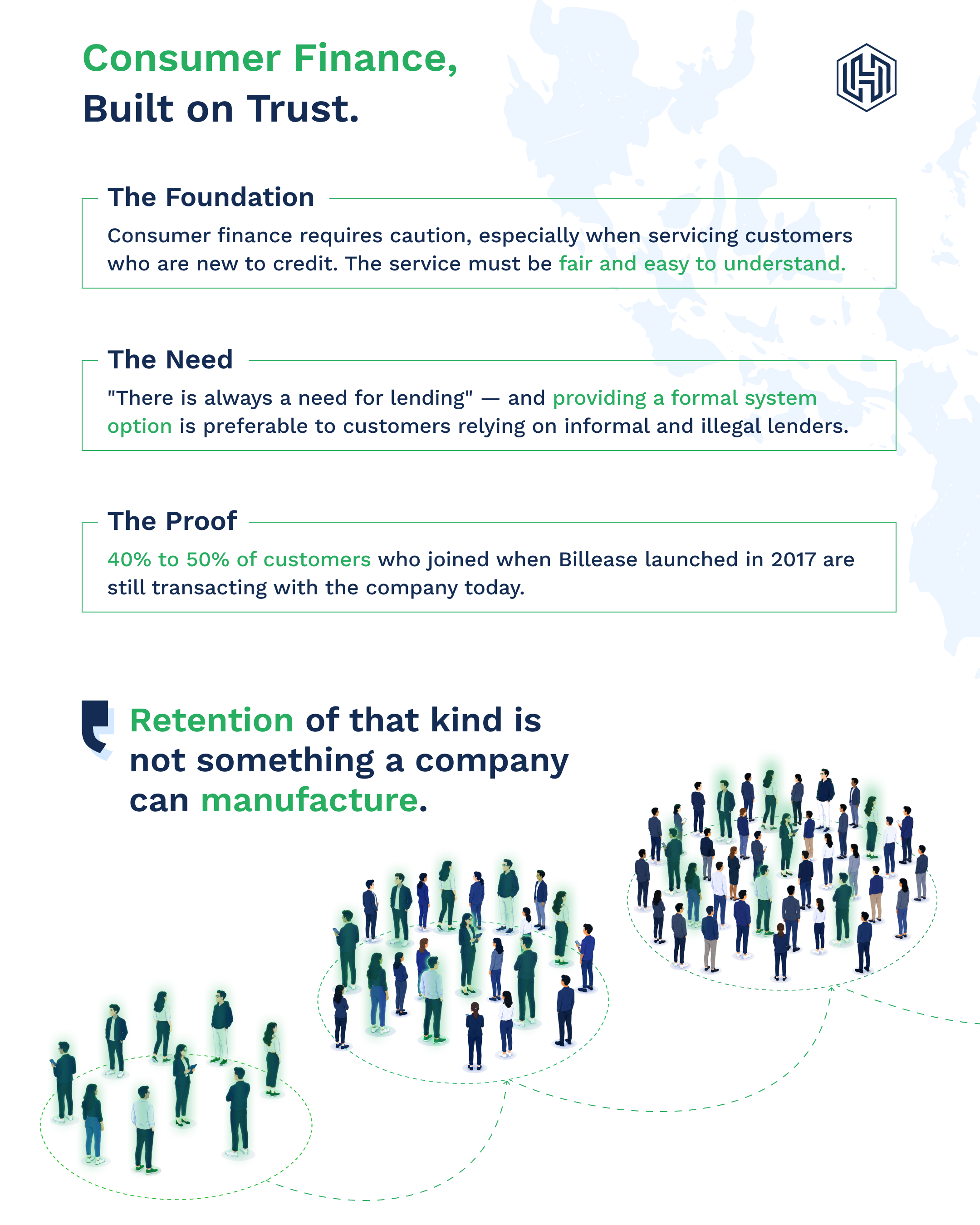
First: Growth. It often takes longer than founders anticipate, particularly in emerging markets where external dependencies are real. Plans should be built with enough runway to absorb that reality.
Second: Discipline. Founders should focus on customers and product first, and make sure the unit economics and retention work before aggressively scaling or raising, in his words, "crazy amounts of money."
His third observation is more personal. He encourages founders to surround themselves with people they genuinely enjoy working with. The journey is a long one, and the energy needed to sustain enthusiasm through it comes, more than anything else, from the people you build alongside.
No conversation about building a lending business in an emerging market is complete without asking about the weather. Cheryl raises what is on every institutional investor's mind: the macro backdrop, and whether Billease is feeling it.
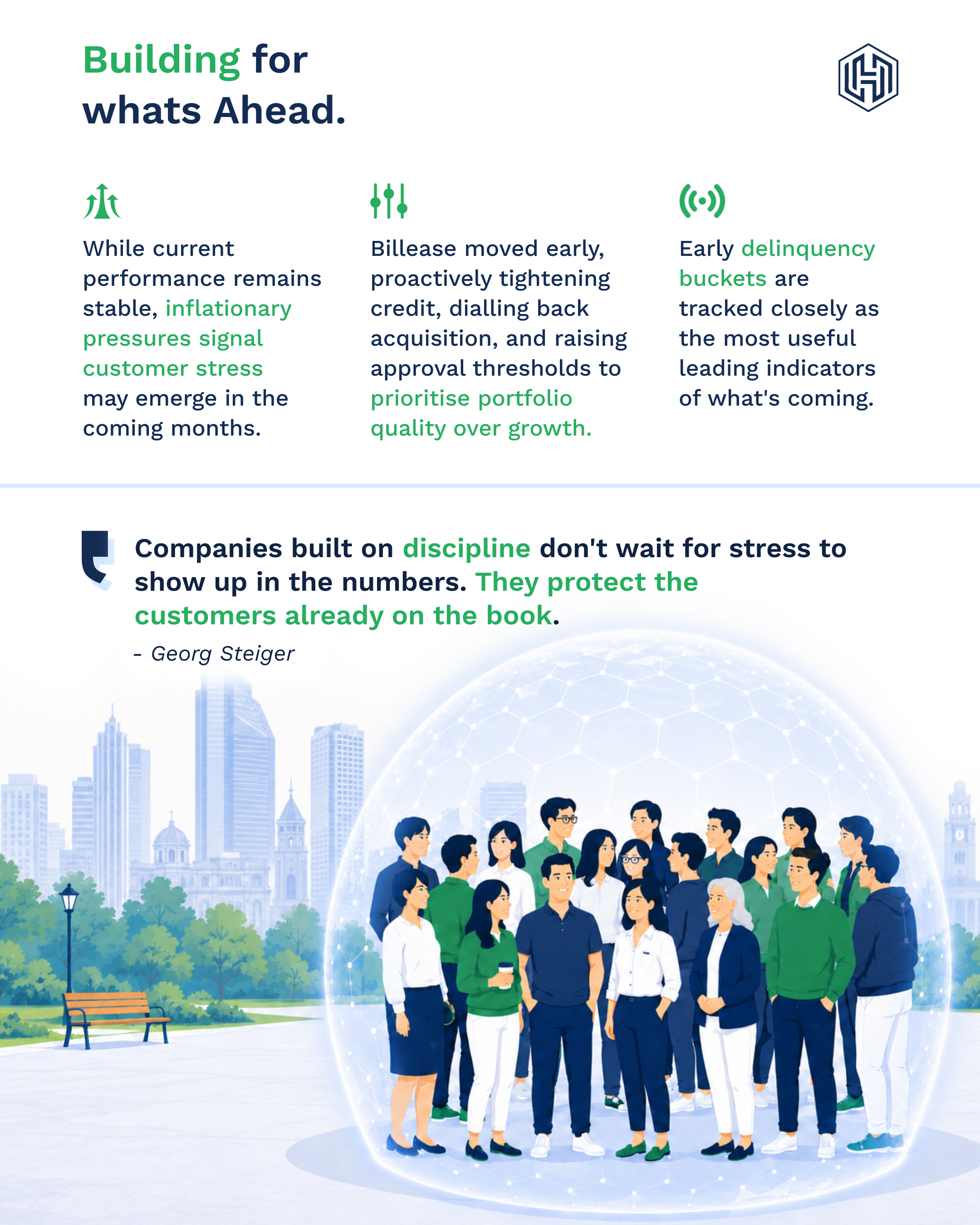
Georg's answer is measured and data-driven. So far, Billease has not seen any immediate changes in transaction volumes, customer spending, or delinquency trends. But he does not offer that as a reason for complacency. While the business has not registered an immediate impact on performance, Georg expects some customer stress to emerge in the coming months as inflationary pressures persist.
What makes the answer distinctive is what comes next. Rather than waiting for stress to show up in the numbers, Billease moved early. The team proactively tightened credit by dialling back acquisition efforts and raising approval thresholds to prioritise portfolio quality. Delinquency trends and customer behaviour are being tracked closely, with particular attention on the early delinquency buckets, which Georg describes as the most useful leading indicators.
It is the kind of response that separates companies built on discipline from those built on momentum. Billease is not chasing the next disbursement. It is protecting the customers already on the book.
The conversation ends on a lighter note, with Cheryl asking what Georg would be doing if he were not a fintech entrepreneur.
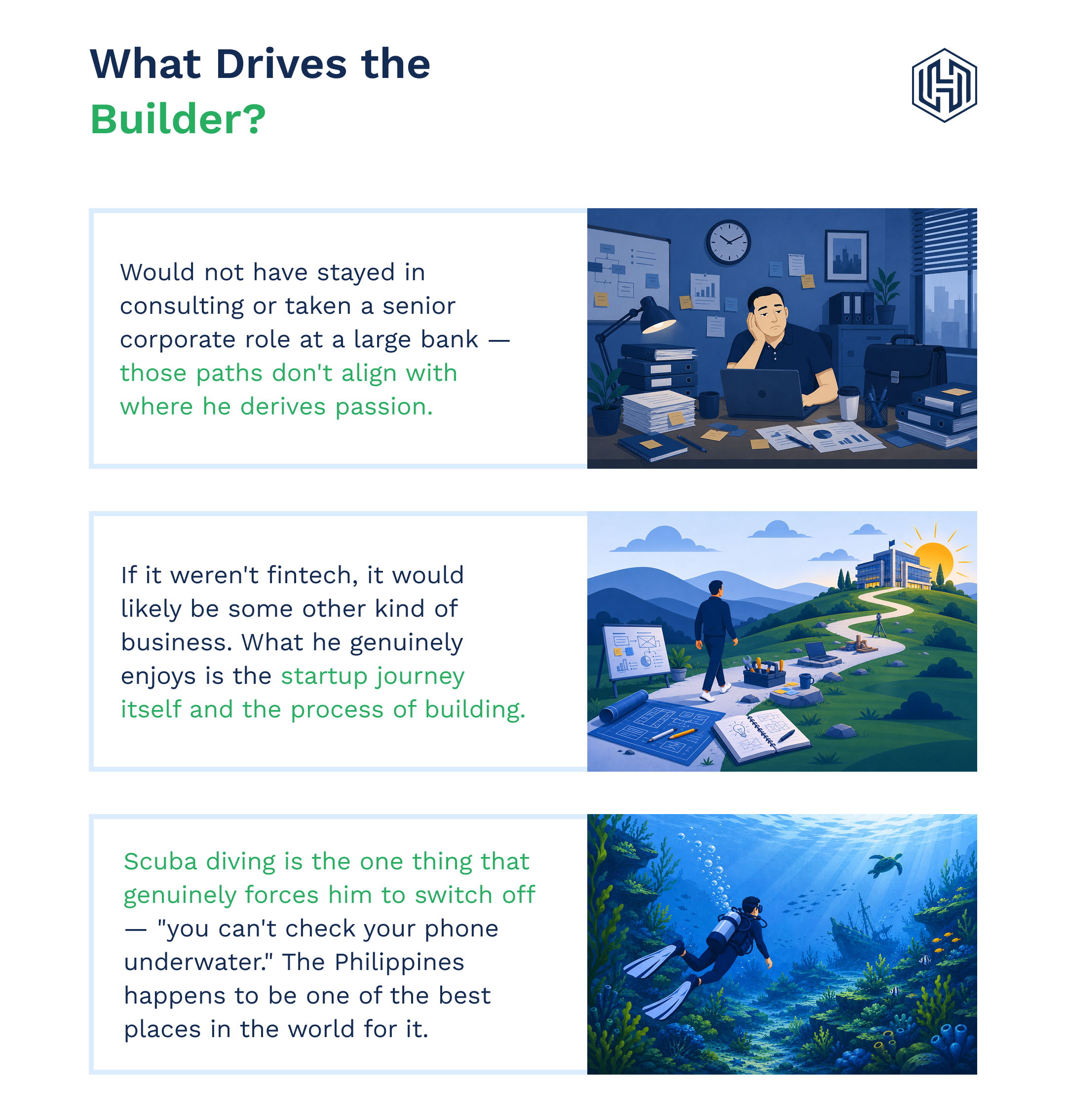
His answer comes quickly. He would not have stayed in consulting, and he would not have taken a senior corporate role at a large bank, as those paths do not align with where he derives passion. If it were not fintech, it would likely be some other kind of business, because what he genuinely enjoys is the startup journey itself and the process of building.
Beyond the conversation, Georg continued to reflect in writing, offering thoughts shaped by years of building in one of Southeast Asia's most dynamic markets. These written responses add a more personal layer to the dialogue, showing a founder who thinks carefully about the company, the customers, and the convictions that hold both together.
Georg's journey is a reminder that the most enduring companies are often built with patience and a steady focus on the customer. His story reflects the value of listening closely, building deliberately, and returning consistently to the mission that set the work in motion.
As Billease moves into its next chapter: a bank, a deposit base, an AI-driven operating model, the company continues to grow in shape and scale, while the direction Georg and his co-founders set a decade ago remains firmly in place.
.png)


Investment involves risk. Past performance is not necessarily a guide to future performance or returns. The value of investments and the income from them can go down as well as up, and you may not get the full amount you invested. Rates of exchange may cause the value of investments to go up or down.
Any forward-looking statements, prediction, projection or forecast on the economy, stock market, bond market or economic trends of the markets contained in this material are subject to market influences and contingent upon matters outside the control of Helicap Pte. Ltd. (“Helicap”) and therefore may not be realised in the future. Further, any opinion or estimate is made on a general basis and subject to change without notice. In presenting the information above, none of Helicap, its affiliates, directors, employees, representatives or agents have given any consideration to, nor have made any investigation of the objective, financial situation or particular need of any user, reader, any specific person or group of persons. Therefore, no representation is made as to the completeness and adequacy of the information to make an informed decision. You should carefully consider (i) whether any investment views and products/ services are appropriate in view of your investment experience, objectives, financial resources and relevant circumstances. You may also wish to seek financial advice through a financial advisor or and independent legal, accounting, regulatory or tax advice, as appropriate.




.png)
