The rich text element allows you to create and format headings, paragraphs, blockquotes, images, and video all in one place instead of having to add and format them individually. Just double-click and easily create content.
Heading 3
Headings, paragraphs, blockquotes, figures, images, and figure captions can all be styled after a class is added to the rich text element using the "When inside of" nested selector system.
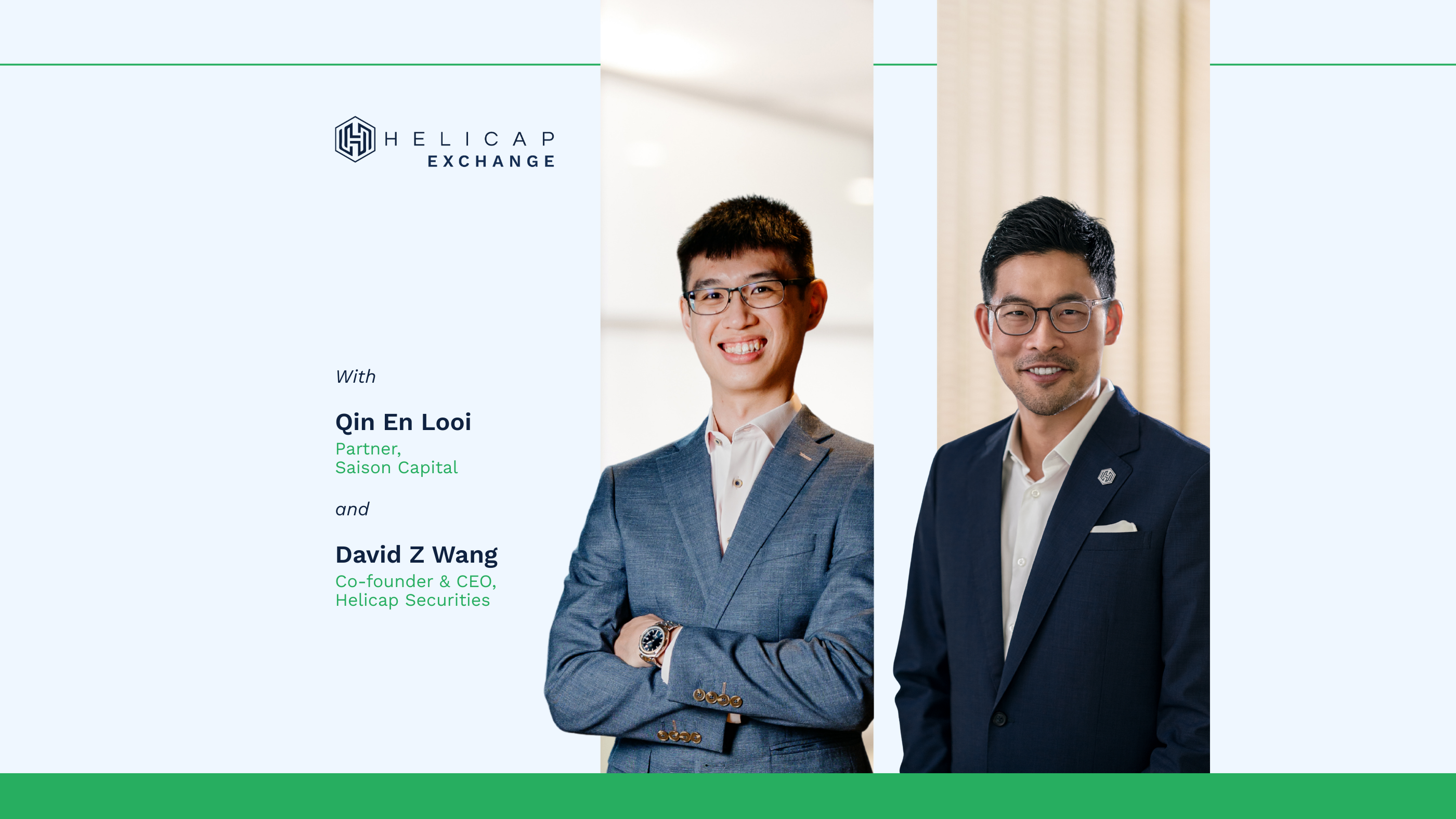
A year after the first edition of Helicap Exchange's Venture Capital vs. Private Credit, Qin En Looi and David Z Wang, came together again for the second edition: Fundraising in the Age of AI.
Qin En, Partner at Saison Capital and Managing Partner at Onigiri Capital, brings experience shaped by entrepreneurship, venture building and investing. He previously co-founded Glints, which has raised more than US$80 million and reached Series D, before joining BCG Digital Ventures as a Venture Architect, where he was the first full-time convert in Southeast Asia. His entrepreneurial track record has also been recognised through his inclusion in Forbes 30 Under 30.
David, Co-founder & CEO of Helicap Securities, brings nearly two decades of experience across global financial markets and private investments, including a decade at Morgan Stanley, Credit Suisse and Nomura, before moving into fintech principal investing and entrepreneurship across Asia. Since co-founding Helicap in 2018, he has driven the firm past US$900 million in transactions as of May 2026. His leadership has been recognised by The Financial Technology Report's Top 50 FinTech CEOs of 2024, Fintech News Network's Top 35 FinTech Founders in Asia, and LinkedIn's Top 12 Influential Voices in FinTech Singapore.
Drawing on distinct vantage points across private credit, venture capital and entrepreneurship, the speakers explored how AI is reshaping the way companies are built, funded and evaluated, alongside the evolving role of debt and equity as businesses scale.
Here are some of the key themes from the discussion with a Q&A section below answering some of the audience questions from the session.
Panel Highlights
[02:02] One Year On: How the Capital Landscape Is Evolving
The conversation opened with a look at what has changed across venture capital and private credit over the past year, reflecting back on their webinar last year. On the venture side, AI has become an increasingly prominent part of funding activity, while private credit continues to attract growing attention across global markets. Together, these shifts are changing how capital providers access where opportunities may emerge and how they fit within a broader allocation strategy.
AI is changing the early-stage fundraising landscape by making it faster and less resource-intensive to build and test products. The discussion looked at how this is shifting expectations around what founders need to demonstrate, with greater emphasis on customer traction, distribution, trust and licensing. As product development becomes more accessible, differentiation is increasingly extending beyond the product itself.
[12:19] Private Credit in a Changing Market Environment
The LinkedIn live session then turned to recent developments in private credit, particularly the significant amount of capital that has entered the US market and how this is shaping activity across the asset class. David reflected on how market conditions can influence lending terms and structures, while Qin En drew parallels with earlier cycles in venture capital. The conversation highlighted the importance of looking beyond headline market movements to the underlying characteristics of individual deals.
[15:29] How Credit Investors Think About Fast-Moving Sectors
AI and software businesses can evolve quickly, creating a different set of considerations for credit investors. David highlighted the role of loan tenor, structuring and ongoing monitoring, including close attention to customer and revenue trends. In these environments, the ability to reassess a business over time can become an important part of the investment approach.
[18:57] The Opportunity for Private Credit in Asia
Asia remains a relatively small share of the global private credit market, despite the scale of the region. The discussion explored some of the factors behind this, including market fragmentation, different legal and operating environments, and the importance of local capabilities. David also noted growing interest from global and regional institutions, with more capital being raised for Asia-focused private credit strategies.
AI activity in Asia remains concentrated among larger companies, while a longer tail of smaller and medium-sized businesses is only beginning to emerge. This next layer of the market is creating opportunities for founders to build more contextualised AI applications around specific customer needs and the region’s fragmented markets.
The discussion also drew an important distinction between the concentration of capital and the concentration of opportunity. While investment remains concentrated among large global and regional players, opportunity may develop more broadly as smaller companies build for individual markets and deepen their understanding of local customers. This creates room for differentiated businesses to emerge by combining AI capabilities with stronger customer and market insight.
[23:55] The Role of Discipline Across Venture Capital and Private Credit
The conversation turned to common misconceptions across both asset classes, and the disciplines that remain important in navigating them. David pointed to the tendency to view private credit too narrowly, rather than as a broad market spanning different loan structures and strategies. Qin En, meanwhile, highlighted the view that price can become secondary in fast-growing sectors such as AI, while emphasising the continued importance of entry price and valuation discipline.
The discussion considered what founders may need to reconsider as AI makes it easier to build and launch products. Beyond the product itself, qualities such as trust, reputation, credibility and a clear understanding of what makes a business distinctive came through as recurring themes. The conversation also returned to the fundamentals of entrepreneurship, including solving a real problem and being clear about where a company’s genuine strengths lie.
The session closed with a broader reflection on how AI may shape professional and investment decision-making. The conversation returned to the importance of judgment, discernment and understanding context, particularly in roles where decisions depend on more than processing information alone. AI may support that process, while the ability to interpret, evaluate and act on information remains central.
From the Audience
The interactive part of the live session then began with questions from the audience. Some of the key parts of those exchanges are captured below.
Question: You mentioned that value now sits in data, trust and licensing. At seed, most of us have very little of all three. What's the bare minimum you'd need to see on each before you'd back someone, and which one do you care about most?
Qin En Looi:
I think the short answer is that it ultimately comes down to a founder’s competitive advantage. I wouldn’t say that one factor is necessarily more important than another. If you want to raise capital, the burden is on the founder to demonstrate why the business is positioned to succeed in that particular market.
Some of the advantages that may previously have stood out, such as having a better product or a stronger engineering team, are becoming less differentiated in the age of AI. By contrast, if a founder can demonstrate that five clients are already prepared to use what they are building, that starts to become very interesting from an investor’s perspective.
So there is no single factor that we prioritise above all others. We tend to evaluate the business more holistically, particularly in terms of its right to win relative to others in the market.
Question: On buy versus build, what convinces you a customer will buy from a startup rather than build it in-house?
Qin En Looi:
It often comes down to priorities. For large organisations, the question may be less about whether they can build a solution internally, and more about whether doing so is the best use of their time and resources.
Using Dave’s example, his team could potentially build a CRM tool, but their time may be better spent sourcing private credit opportunities. In that context, buying an existing solution may make more sense.
For founders, the key is to understand the customer’s priorities and demonstrate clear demand for the product.
Question: As a private credit investor, where is Helicap finding opportunities to lend within the Asian AI ecosystem to fund the region's next winners?
David Z Wang:
We cover Asia, with a significant focus on emerging markets. Today, much of the region’s AI activity is concentrated in Korea, Japan, China and Taiwan, where larger funds are also participating in sizable transactions.
At Helicap, we typically operate in the US$5 million to US$50 million range, a more specialised segment of the market. We have been looking at FinTech and SaaS models, with customer retention among the areas we pay close attention to. For example, we have used platforms such as Dropbox and HubSpot for several years, reflecting the stickiness that can develop when a product continues to meet a customer’s needs.
Understanding that behaviour can provide useful insight beyond the financial statements alone, which is why we also look closely at underlying customer activity and individual transactions.
More broadly, we are seeing opportunities across Malaysia, Thailand and Australia in areas such as data centres and infrastructure. These are areas we continue to explore as the ecosystem develops.
For those working on relevant opportunities, please feel free to connect with me on LinkedIn. I’m happy to continue the conversation.
Question: As an early-stage investor in a sector like AI, where, as you mentioned, valuations can be overstated, has this shaped your exit strategy as a fund? And how does the exit landscape differ across regions?
Qin En Looi:
Every fund manager will have a different approach. For us, price is one of the important factors we consider. This also relates to the question of whether we foresee a correction in the short to medium term. The reality is that it is difficult to predict.
There still appears to be strong momentum in the market, but fundamentally, we remain very conscious of maintaining valuation discipline. It can be easy to get caught up in narratives around companies raising significant amounts of capital or achieving very high valuations.
There will always be exceptional companies that achieve exceptional outcomes, but we prefer to take a pragmatic approach rather than assume that every company will follow the same trajectory. Fundamentally, price discipline continues to matter, and that remains an important part of our investment approach.
Question: For venture capital in Asia, what would be the industry breakdown in terms of investments committed? Would AI-related investments take the main share, as in the US? In terms of marking, is it currently a challenge?
Qin En Looi:
I think the dynamics will be broadly similar to those in the US and globally, where a significant share of investment activity is increasingly associated with AI.
AI is becoming a core technology, much like cloud infrastructure has over time. Today, we generally do not ask whether a company is building on the cloud, just as we would not necessarily ask whether a digital product is mobile-ready. These have increasingly become baseline expectations, and AI may be moving in a similar direction.
In that context, marking these investments and determining valuations will likely remain challenging, given how quickly the sector is evolving.
CoreWeave is one example that illustrates some of this volatility, having experienced a significant run-up, followed by a correction and subsequent recovery. Similar dynamics may emerge elsewhere in the market, although the extent of any correction remains difficult to predict.
Question: How do I best approach business angels in Asia? I am building a B2B RegTech for banks worldwide based on AI and ML.
Qin En Looi:
I think one of the most important things is to spend time meeting people and building relationships in person. There is still no real substitute for the trust and rapport that can develop through face-to-face interaction.
Where that is not possible, calls can also be valuable. Particularly when approaching business angels, building genuine relationships and establishing trust can play an important role in the process.
David Z Wang:
I often think about this through what I call the ABC approach. If I want to reach C, which in this case is the business angel, I first look for a B who knows me, understands what I am building and can make the introduction.
That creates a degree of validation before the conversation even begins, as the introduction comes through someone the investor already knows or trusts. It is similar in principle to a B2B2C model.
One approach, therefore, is to identify four or five people who know you well, believe in what you are building and would be comfortable making an introduction. Business angel networks and industry events can also provide useful avenues for developing those relationships.
Question: With AI becoming such a big part of the industry, how should fresh graduates adapt to this? What skills should we focus on?
Qin En Looi:
I think the skills that remain important are the human skills, including communication, persuasion and trust-building. Those continue to be highly relevant.
AI tools such as GPT and Claude are incredibly useful, and there is naturally a lot of excitement around what they can do. At the same time, AI can make mistakes, and many of the capabilities available to one person are also available to others using the same tools.
What these models do not fully capture are the insights, context and relationships that come from interacting with people. That is why I would still encourage graduates to spend time meeting others, having conversations and building genuine relationships.
I give my own team a similar message when we conduct industry research. Today, using AI for desktop research is a baseline expectation, but it should be complemented by speaking with experts, understanding what is happening on the ground, and validating what the initial research suggests.
Very often, those conversations provide a level of depth and context that AI alone may not capture. So whether someone is looking for employment or investment, there remains significant value in learning directly from people and real-world interactions.
David Z Wang:
I think hard skills continue to matter as well. Today, we are seeing people build capabilities through areas such as computing, coding and other technical disciplines, and those skills are increasingly important.
Interpersonal skills may help someone build relationships and create opportunities, but they also need to be supported by substantive capabilities. There is always room to learn on the job, but having already invested time in developing relevant skills can provide a stronger foundation.
So I would encourage graduates to continue building both sides: the technical capabilities that are increasingly expected in the workplace, alongside the communication and relationship-building skills that Qin En mentioned.
Question: AI may change how investors assess risk, but could it also change how founders decide when equity is worth giving up versus taking on debt? And more specifically, what is the right cost and structure of capital for the business?
Qin En Looi:
At the early stages, equity is generally the easier option to raise, as the bar for credit typically includes reliable and consistent cash flows and evidence that the company is able to repay. In that sense, the two can often be approached in stages, with equity coming first and debt introduced as the business develops.
At the end of the day, fundraising operates within a willing buyer, willing seller market. Founders also need to recognise that they may not always be in a position to determine the terms independently, as investors will have their own views on valuation and structure. For that reason, I think it is more useful to focus on the areas within the founder’s control: How do you grow the business? How do you demonstrate traction? How do you continue strengthening the fundamentals of the company?
Questions around valuation and how much equity to give up are ultimately part of the fundraising process, but they are often outcomes of those underlying fundamentals. If the business is performing well, the discussion then becomes one of negotiating a valuation and structure that both sides can accept. At an early stage, I would therefore be cautious about over-optimising around whether the company should sell 5% or 10%, or whether it should be valued at 10 million or 20 million. Those questions may be less important than building the business and creating genuine investor demand.
David Z Wang:
From the debt perspective, the benefit of non-dilution is well understood, but there is also a direct cost involved, as interest may need to be paid monthly, quarterly or semi-annually. For example, if the interest rate is 8% and a company borrows US$1 million, that represents US$80,000 in annual interest.
So one of the key questions we discuss with founders is how the capital will be used and over what timeframe. If the funding is not expected to be deployed for another two years, debt may be less suitable given the ongoing cost of interest.
By contrast, if the company has a contract that requires funding, with a clear path to revenue growth and repayment over the loan period, the rationale for debt can be much stronger. The key is to ensure that the capital can be put to productive use within a reasonable timeframe, given the obligation to service the interest.
Question: How can a startup company engage Helicap to raise funds for them? What are the criteria Helicap looks at before raising funds for them?
David Z. Wang:
There are other firms that focus more on earlier-stage companies and startups, while Helicap typically looks at businesses at a later stage. We generally look for a meaningful level of revenue, a clear organisational structure and, traditionally, companies with around five years or more of operating history. With AI, there may be opportunities to consider companies earlier, but that has typically been our approach.
We also look for a strong management team and investor base. Beyond the amount of capital involved, it is important for us to see a differentiated business with the ability to generate revenue consistently, rather than on a one-off basis.
For startups that may not yet have dedicated CFO, accounting or finance support, it can also be valuable to invest in those capabilities, whether through part-time support or other arrangements. Accurate financial information and reporting are particularly important when working with lenders, where monthly or quarterly reporting is often expected. The reporting requirements in private credit can therefore be more extensive than those typically seen in venture capital.
Qin En Looi:
Ultimately, fundraising remains a core responsibility of the founder. There are resources and partners that can support the process, but particularly at the early stages, investors generally expect founders to take the lead.
On the venture capital side, we typically want to engage directly with the founders. There may be circumstances or markets where bankers or other intermediaries play a role, but at the pre-seed stage, direct founder involvement is generally important.
As companies grow and their financing needs become more complex, working with specialised partners can become increasingly relevant, as Dave mentioned. Even then, however, founders remain central to the process and need to be comfortable communicating the company’s story, strategy and value proposition to investors.
Question: With regards to private credit in the AI infrastructure space in Southeast Asia, I assume that it has become quite competitive, especially with these larger private credit players. How would Helicap potentially work on integrating that space? Syndicating deals with other funds is an option, but how is the relationship between private credit players in Singapore and even Southeast Asia overall? Do we see collaboration, or is everyone just fighting for their piece of the pie?
David Z. Wang:
At Helicap, we have a licensed syndication desk and work with around 300 partners. Building that network has taken time, particularly as we also manage our own fund, so it has been important to establish that the syndication platform is focused on helping transactions move forward in a constructive way.
Beyond the commercial aspects, governance is a very important part of private credit. We need access to reliable data, clear reporting and confidence that the company is operating and performing as expected. In some cases, we also work closely with companies to help strengthen their financial processes and reporting frameworks.
This is an area that companies can sometimes underestimate. Product, revenue and partnerships are important, but so are stakeholder management and the quality of financial reporting. Strong governance and reporting can make a meaningful difference when engaging with larger institutional investors.
Qin En Looi:
There is certainly a competitive element to the market. In venture capital, for example, investors are not simply waiting for founders to approach them; they are also actively identifying companies they would like to work with.
A key question for us is understanding our right to win and how we earn the opportunity to work with founders. Having capital alone does not necessarily guarantee a place on the cap table, particularly when it comes to highly sought-after companies.
That is why we spend a significant amount of time strengthening the support we provide to portfolio companies and leveraging our institutional networks and resources. It remains a competitive environment, so we continue to focus on where we can differentiate and how we can create value for the companies we back.
We hope the discussion offered a useful perspective on how AI is reshaping fundraising, capital allocation and company growth across venture capital and private credit. Thank you for tuning into the webinar.
Please feel free to follow our speakers, David Z Wang and Qin En Looi, on LinkedIn to stay connected with their work and viewpoints.
Additionally, if you would like more insight on how private credit is evolving across Asia, we encourage you to subscribe to Helicap newsletter.
Disclaimer: This article is based on Helicap's webinar, Venture Capital vs. Private Credit: Fundraising in the Age of AI. It is provided for informational purposes only and does not constitute investment advice, an offer, or a solicitation to invest.
Beyond the Balance Sheet: A Dialogue with Georg Steiger
Georg Steiger, Co-founder and CEO of Billease, joins Helicap's Cheryl Tay to talk about what it takes to build one of the Philippines' leading consumer fintech platforms from the ground up.
Beyond the Balance Sheet: Reuben Lai on Fintech and Regenerative Finance
From building Grab Financial Group and GXS Bank to reviving degraded lands through AI-enabled restoration, Arkadiah Co-Founder Reuben Lai shows how the future can be both innovative and regenerative.
Private Credit vs Venture Capital: Key Differences Explained
Two of Asia's leading finance voices, Qin En Looi of Saison Capital and David Z. Wang of Helicap came together in Helicap Exchange’s first live debate to explore the future of capital. The discussion revealed private credit as a discipline of stability and venture capital as a vision of growth, with both leaders recognising that enduring wealth lies in knowing when to anchor in certainty and when to pursue possibility.


.png)





.png)
