Keep up with the latest FinTech and private market news, business tips, and thought leadership from industry leaders, mentors, and professionals.
Join our mailing list to receive information on upcoming Helicap platform updates and webinars.

If you're excited about the potential of private markets and fintech, we've got a job for you.
The evolution of financial services is closely tied to the history, geography and economic realities of each market. Over time, these factors influence how financial systems develop, how money moves through the economy and how individuals and businesses access financial services.
The Philippines offers an interesting example of this. Its archipelagic geography, the varying availability of traditional banking services across regions and the practical realities of accessing formal finance have historically played a role in shaping the country's financial landscape.1 For households and small businesses, factors such as distance, cost and documentation requirements,2 have also presented challenges in accessing formal financial services.
Against this backdrop, the expansion of digital financial services, supported by the growing presence of fintech platforms, has introduced additional ways for individuals and businesses to make payments, conduct transactions and access financial products. From digital payments to banking and lending, these developments reflect how digital finance is becoming increasingly embedded within Philippines’ broader financial landscape.
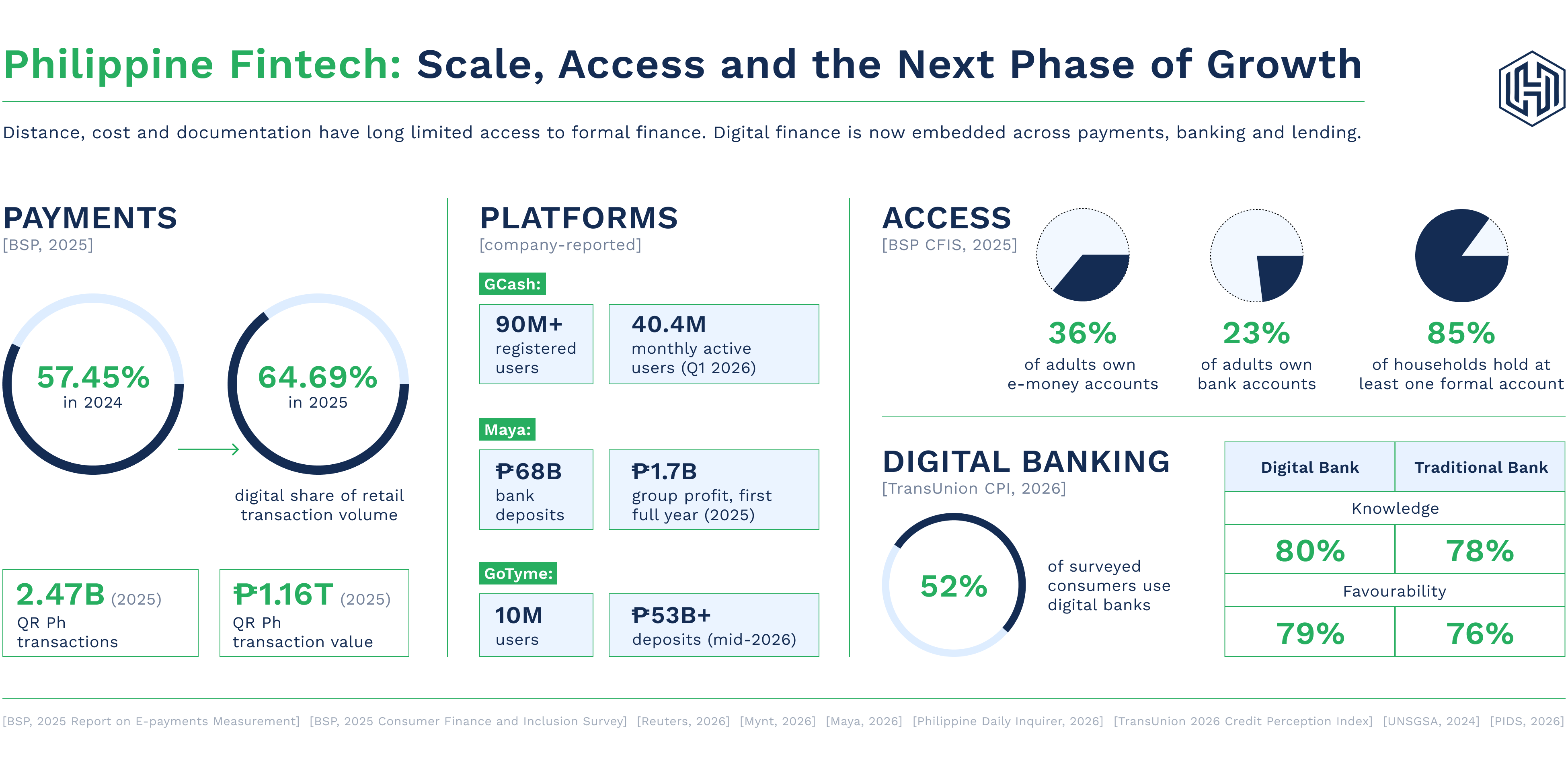
In 2025, the Bangko Sentral ng Pilipinas (BSP) reported that digital payments accounted for 64.69% of retail transaction volume,3 up from 57.45% in 2024, while QR Ph transactions rose to 2.47 billion, with a total value of ₱1.16 trillion.3 These figures point to a market where digital payment infrastructure has become part of the fabric of everyday commerce in the Philippines.
Mynt’s IPO listing on the Philippine Stock Exchange4 (PSE) offers a timely marker of how far the country’s fintech platforms have evolved within that landscape. As the group behind GCash and Fuse Financing, its trajectory reflects broader shifts in how digital finance has taken hold. GCash reported 40.4 million monthly active users in the first quarter of 2026,5 which it benchmarked at roughly 55% of the country’s adult demographic. The active user base is drawn from over 90 million registered accounts,6 in a nation of over 100 million, as reflected in both official census data7 and broader population estimates.8
GCash is not alone in this trajectory. Across the broader platform landscape, Maya Bank reached ₱68 billion in deposits, while its broader Maya Group recorded its first full-year profit of ₱1.7 billion in 2025.9 GoTyme, which launched in 2022, had reached 10 million users and more than ₱53 billion in deposits by mid-2026.10 Taken together, these platforms reflect how the earlier phase of digital adoption is giving way to a broader presence within the financial system.
These figures become more meaningful when set against how Filipinos access formal finance more broadly. According to BSP’s 2025 Consumer Finance and Inclusion Survey (CFIS), e-money account ownership among Filipino adults stood at 36%, compared with 23% for bank accounts, while 85% of households had access to at least one formal financial account.11 Digital banking is following a similar trajectory: according to TransUnion's 2026 Credit Perception Index (CPI), 52% of surveyed consumers reported using digital banks, which also outpaced traditional banks in consumer knowledge (80% vs 78%) and favourability (79% vs 76%).12
The significance of this shift becomes clearer when set against the constraints that have historically shaped the reach of traditional finance. The BSP’s National Strategy for Financial Inclusion (2022–2028) identifies documentary requirements, account maintenance costs, and distance from financial institutions among the practical barriers for individuals.13 For MSMEs, the challenges are particularly evident. Bank lending to the sector reached ₱575 billion by the end of 2025, accounting for just 4.7% of the banking industry's total loan portfolio.14 Limited collateral, perceived credit risks and the operational costs of MSME lending remain among the constraints affecting access to financing.15
Digital platforms offer a different approach to some of these challenges. Payments, transfers and other digital transactions generate data that can provide additional inputs for credit assessment, particularly for borrowers with limited conventional credit histories. The International Finance Corporation's (IFC) 2026 report identifies transaction data, including from mobile money and digital wallets, as the most common input for non-traditional credit scoring models.16
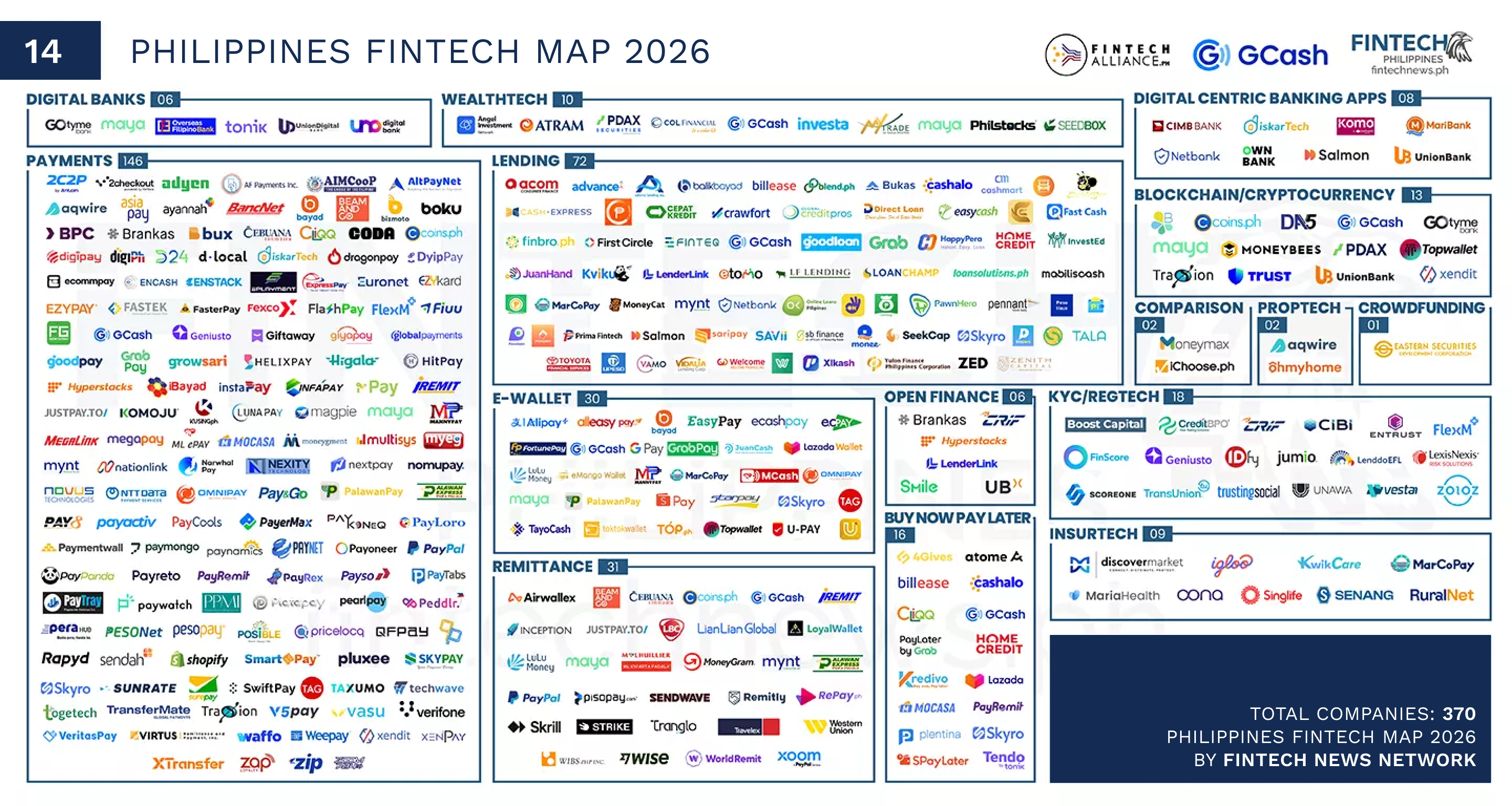
The Philippine fintech market now encompasses more than 300 companies operating across payments, digital banking, lending, wealth management, insurtech and embedded finance.17 Payments and fund transfers represent an estimated 45% of the market,18 while personal remittances exceeded US$40 billion in 2025,17 underscoring the broader importance of money movement within the Philippine economy.
Beyond facilitating transactions, digital-first platforms are increasingly building on their consumer networks and transaction data,19 creating opportunities to expand into lending and other financial services. Remittances and peer-to-peer corridors also help generate recurring transaction activity that can support broader financial product offerings.19 This expansion is evident across different lending segments. According to BCG, digital players are gaining ground in both consumer and MSME lending, although their share of the broader market remains relatively small. In consumer lending, products such as buy-now-pay-later (BNPL) and cash loans are prominent areas of fintech activity. Meanwhile, fintech lenders are increasingly using transaction data and cash flow assessments to extend working capital financing to smaller businesses.19
Partnerships are also shaping how these financing solutions are delivered. MySuki’s partnership with Security Bank combines supply-chain digitisation with inventory financing for a network of approximately 300,000 sari-sari store users, embedding credit into their existing commercial activities.20
As these lending models evolve, access to business financing remains an important area of focus across the region. In Southeast Asia, up to 60% of MSMEs report difficulty obtaining financing.21 As fintech platforms develop different approaches to meeting these financing needs, the capital structures supporting their credit portfolios are also becoming increasingly relevant.
The digital lending loan book balance in the Philippines reached US$4.26 billion in 2025, up 11% from US$3.84 billion in 2024.22 At the platform level, Fuse reported ₱451 billion in cumulative disbursements to 11.5 million borrowers by Q2 2026,23 while Maya had disbursed ₱256 billion in loans since 2022.24 Although these figures measure different aspects of lending activity, they illustrate the scale of credit being extended through digital platforms.
As lending activity expands, institutions are participating through different financing structures:
Together, these transactions illustrate the different ways institutions are supporting the expansion of fintech lending, from direct loans to revolving credit facilities and asset-backed financing structures.
Private credit plays a growing and supportive role in the changing financial landscape. An International Monetary Fund’s Global Financial Stability Report from April 2026 shows that private credit in emerging markets has played a largely complementary role to regulated financial institutions,28 providing asset-backed financing and risk-transfer structures that can help release balance sheet capacity for banks, non-bank financial institutions (NBFIs) and fintech firms as they scale their lending activity. Across emerging markets more broadly, private credit transaction volumes rose from around US$14 billion in 2024 to more than US$22 billion in 2025.29
The Philippine fintech ecosystem has matured significantly, shifting from basic digital payments into consumer and business lending. Mynt's listing on the Philippine Stock Exchange marks an important milestone in this journey, reflecting the scale achieved by homegrown platforms and the broader financial services ecosystem taking shape around them.
As the market develops, the focus extends beyond digital reach to the financing needed to support a wider range of credit activities. Recent transactions offer a view into how banks, development institutions and other capital providers are participating in this growth, with different structures emerging to support different lending portfolios.
The Philippines remains an important market within Asia's evolving financial landscape. Its growing fintech and lending ecosystem offers a compelling perspective on how digital innovation, credit and institutional capital are coming together, and the potential role they could play in expanding financial access and shaping the next phase of growth across the region.
For more insights, explore these related pieces from Helicap.
Stay connected with Helicap on LinkedIn and subscribe to our newsletter for the latest perspectives on private credit, fintech and financial markets across Asia.
This article is for general informational purposes only and does not constitute financial advice, a recommendation, an offer, or a solicitation to invest in any financial product. Any investment product referenced is offered only to verified Accredited Investors and Institutional Investors (each as defined in Section 4A under the Securities and Futures Act 2001). If you are not an Accredited Investor or Institutional Investor, the investment products referenced in this article are not available to you. All investments carry risk, including the possible loss of principal. Past performance is not indicative of future results.




Investment involves risk. Past performance is not necessarily a guide to future performance or returns. The value of investments and the income from them can go down as well as up, and you may not get the full amount you invested. Rates of exchange may cause the value of investments to go up or down.
Any forward-looking statements, prediction, projection or forecast on the economy, stock market, bond market or economic trends of the markets contained in this material are subject to market influences and contingent upon matters outside the control of Helicap Pte. Ltd. (“Helicap”) and therefore may not be realised in the future. Further, any opinion or estimate is made on a general basis and subject to change without notice. In presenting the information above, none of Helicap, its affiliates, directors, employees, representatives or agents have given any consideration to, nor have made any investigation of the objective, financial situation or particular need of any user, reader, any specific person or group of persons. Therefore, no representation is made as to the completeness and adequacy of the information to make an informed decision. You should carefully consider (i) whether any investment views and products/ services are appropriate in view of your investment experience, objectives, financial resources and relevant circumstances. You may also wish to seek financial advice through a financial advisor or and independent legal, accounting, regulatory or tax advice, as appropriate.